
Northwest Passage Cruise: Routes, Cost, Ships, Best Time and What to Expect

A Northwest Passage cruise takes you through one of the Arctic’s most remote sea routes, but it is not a typical cruise holiday. The journey can involve ice, rougher seas, small communities, wildlife sightings, and shore landings far from major tourist ports. I think that is exactly why choosing the right route, ship, and time of year matters. One wrong assumption about the itinerary can change the whole trip.
What stands out most is how unpredictable the experience can be. The route depends on sea ice, weather, and local conditions, so a planned landing may change or disappear. That is part of expedition cruising. You might spend one morning watching for polar bears and the next stepping ashore in an Inuit community. It can feel very different from the fixed schedule of a conventional cruise.
In this guide, you’ll get a clearer picture of what a Northwest Passage cruise actually involves. You’ll learn about routes, cruise length, ships, costs, the best months to go, wildlife, and what happens during a typical expedition day. You’ll also see the practical differences between cruise operators and what to check before paying for a cabin.
So, before comparing prices or choosing a cruise line, it helps to understand the journey itself. The Northwest Passage is not one simple route, and not every cruise crosses the entire passage. Keep reading, because those details can make a big difference to what you see, what you pay, and what kind of Arctic experience you get.
What Is the Northwest Passage?
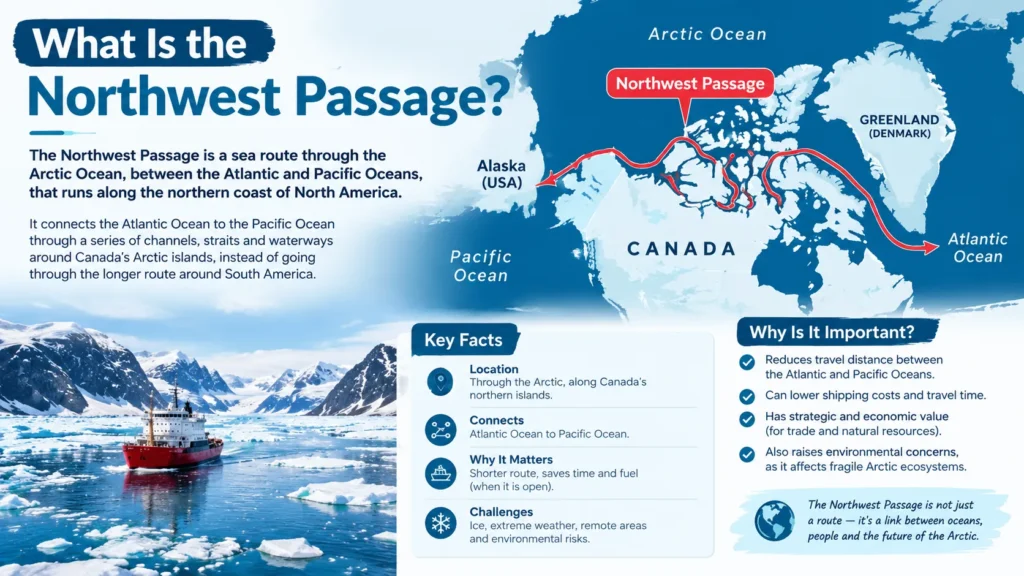
The Northwest Passage is a network of Arctic waterways through Canada’s Arctic Archipelago connecting the Atlantic and Pacific oceans.
It is not one simple channel running across Canada.
There are multiple possible routes through the Arctic islands, and ice conditions have historically made navigation difficult. The passage became famous because European explorers spent centuries searching for a navigable route between the two oceans.
The historical side of the Northwest Passage is still part of many modern cruises.
Sir John Franklin’s 1845 expedition is often discussed during voyages. Responsible Travel, for example, mentions Beechey Island and Victory Point as places connected with the Franklin expedition.
Roald Amundsen later became the first person to successfully navigate the Northwest Passage from east to west, completing the journey in 1906.
Today, passengers can travel through parts of the same region aboard expedition ships, but the purpose is very different. You’re there to experience the Arctic, not to find a commercial shortcut between Europe and Asia.
What Makes a Northwest Passage Cruise Different?
A Northwest Passage cruise is normally built around expedition activities.
That can mean getting into a Zodiac after breakfast, going ashore for a few hours, returning to the ship for lunch, then heading out again later if conditions allow.
The exact schedule changes.
Possible activities include:
- Zodiac landings
- Wildlife watching
- Hiking
- Kayaking
- Photography
- Visits to Arctic communities
- Historical sites
- Naturalist-led excursions
- Lectures
- Citizen science activities
Viking’s current itinerary, for example, lists kayaking, Zodiac shore landings and exploration in the Canadian High Arctic. Its expedition equipment includes kayaks, Zodiacs and special operations boats.
HX also operates a science program onboard its expedition ships, with facilities for photography, biology and other workshops. Its passengers can participate in citizen science projects involving areas such as cloud research, seaweed biodiversity and phytoplankton.
That gives you a better idea of what “expedition cruise” means here.
It isn’t just a cruise ship moving between ports while passengers spend most of the day onboard.
Also view: Yourtown Prize Home: How the Draw Works
Northwest Passage Cruise Routes
There isn’t one standard Northwest Passage cruise route.
This is one of the first things to check when you’re comparing itineraries.
A shorter voyage might cover part of the Canadian Arctic. A longer expedition may attempt a much larger east-to-west or west-to-east crossing.
Responsible Travel gives an example of a roughly two-week cruise between Cambridge Bay and West Greenland, while its guide says a full passage from Greenland to the Beaufort Sea and northern Alaska can take around a month.
Current HX itineraries show the same variation.
Its published 2027 program includes a 25-day Northwest Passage expedition from Seattle to Reykjavík, another 25-day voyage from Reykjavík to Seattle, and separate 21-day itineraries around Baffin Island.
So two cruises can both be called “Northwest Passage cruises” while offering very different trips.
East-to-West Northwest Passage Cruises
East-to-west voyages generally approach the passage from Greenland or the eastern Canadian Arctic and travel toward the western Arctic.
Some longer itineraries can continue toward Alaska and the Beaufort Sea.
This is the direction most often associated with the classic full transit, although the exact route depends on the operator and sailing.
West-to-East Northwest Passage Cruises
West-to-east cruises reverse the general direction.
For a traveler, the direction itself is less important than what is actually included.
Check:
- Starting port
- Ending port
- Canadian Arctic locations
- Greenland stops
- Baffin Island
- Inuit communities
- Wildlife areas
- Number of expedition days
- Planned shore landings
Do All Northwest Passage Cruises Complete the Passage?
No.
This is an easy mistake to make when reading cruise descriptions.
Swan Hellenic explicitly points out that Northwest Passage expeditions can vary in scope, with some making a full transit and others visiting selected sections. Its own Northwest Passage & Northern Lights itinerary focuses on Greenland and the eastern Canadian Arctic rather than claiming a full east-to-west transit.
So if completing the historic passage is important to you, confirm exactly what “Northwest Passage” means for that particular sailing.
Don’t assume the name guarantees a full transit.
Northwest Passage Cruise Map: Where Does the Route Go?
A Northwest Passage cruise map can include a large area of the Arctic.
Depending on the itinerary, you may see places such as:
- Greenland
- Baffin Island
- Nunavut
- Pond Inlet
- Lancaster Sound
- Beechey Island
- Canadian Arctic islands
- Beaufort Sea
- Alaska
The exact combination depends on the voyage.
For example, Viking’s current 13-day itinerary includes Nuuk, Greenland, Ilulissat, Uummannaq, Baffin Bay, Pond Inlet and several days in the Canadian High Arctic.
That is useful when reading a map because the phrase “Northwest Passage cruise” doesn’t tell you enough by itself.
Look at the actual stops.
Why Northwest Passage Routes Can Change
The Arctic is not a normal cruise environment.
Sea ice moves. Weather changes. Visibility can deteriorate. Wildlife can appear in areas that were not part of the original plan.
Responsible Travel explains that the captain and expedition leader can adjust the direction and landing locations based on weather, ice and wildlife.
Swan Hellenic makes the same point. Its current information says that shifting ice and weather can affect the route, landings and activities.
This is why a Northwest Passage cruise should be booked with some flexibility.
If you need every port and excursion to happen exactly as printed, this type of expedition may not suit you.
How Long Is a Northwest Passage Cruise?
The length depends on how much of the Arctic the itinerary covers.
A shorter Northwest Passage cruise can be around two weeks.
Longer expeditions can run for three weeks or more.
Some full-passage itineraries approach a month.
Current HX examples make the range quite clear. Its published 2027 itineraries include 25-day Northwest Passage voyages, 21-day Baffin Island itineraries and a 19-day Arctic Canada and Greenland expedition.
Swan Hellenic also describes a 14-night Northwest Passage and Northern Lights itinerary covering Greenland and the Canadian Arctic.
So don’t compare cruises based only on the number of nights.
A 14-night itinerary that concentrates on Greenland and eastern Canada is not the same product as a 25-day voyage attempting a much longer Northwest Passage route.
When Is the Best Time for a Northwest Passage Cruise?
The main cruise season is during the short Arctic summer.
The exact operating window varies by route and operator.
Responsible Travel describes its Northwest Passage sailing window as August to September, when the narrow channels are more accessible, while Swan Hellenic describes the broader cruise season as July through September.
The reason is straightforward.
Sea ice affects navigation.
During the Arctic summer, seasonal sea ice usually reaches lower levels, making some areas more accessible. That does not mean the route becomes completely predictable. Ice conditions still vary from year to year.
July
July gives you long Arctic daylight and can be a good period for wildlife and bird activity.
The exact experience depends on the route.
August
August is an important month for many Northwest Passage expeditions.
It falls within the short summer navigation season and can offer opportunities for wildlife watching, shore landings and outdoor activities.
September
September is later in the season.
It can bring shorter days and different light conditions. It may also provide better opportunities for Northern Lights viewing than the brighter summer months, although there is never a guarantee.
Responsible Travel specifically recommends September for travelers interested in increasing their chances of seeing the Northern Lights during a Northwest Passage cruise.
What Wildlife Can You See on a Northwest Passage Cruise?
Wildlife is one of the main reasons people book an Arctic expedition.
Possible sightings include:
- Polar bears
- Narwhals
- Beluga whales
- Bowhead whales
- Humpback whales
- Seals
- Walruses
- Arctic foxes
- Caribou
- Musk ox
- Seabirds
But there is an important distinction between “possible to see” and “guaranteed to see.”
There are no guaranteed polar bear sightings.
There are no guaranteed whale sightings either.
Responsible Travel describes Cunningham Inlet on Somerset Island as a summer location where beluga whales gather, and notes possible sightings of narwhals and several whale species around Baffin Island. It also lists Arctic foxes, snow geese, caribou and musk ox among possible wildlife sightings around Banks Island.
This is another reason expedition flexibility matters.
If wildlife appears in an area outside the original schedule, the expedition team may try to take advantage of the opportunity when conditions allow.
Polar Bears
Polar bears are one of the biggest attractions for many travelers.
They are Arctic animals associated with sea ice, so sightings depend heavily on location, season and current conditions.
Treat any polar bear encounter as a wildlife opportunity rather than something the cruise can promise.
Whales
Depending on the route, you may look for:
- Belugas
- Narwhals
- Bowhead whales
- Humpback whales
- Fin whales
- Other marine mammals
The best locations and periods differ between species.
Birds
Birdwatching can be surprisingly important on a Northwest Passage cruise.
Responsible Travel describes Prince Leopold Island as an important seabird location, with large colonies of kittiwakes, guillemots and puffins.
Bring binoculars.
You’ll use them.
Inuit Communities and Culture
The Northwest Passage is not an empty region waiting to be discovered by cruise passengers.
Inuit communities have lived in the Canadian Arctic for generations, with knowledge and traditions closely connected to the land, water, weather and wildlife.
Some expedition itineraries include community visits.
These visits can provide opportunities to learn about:
- Inuit history
- Contemporary life
- Traditional knowledge
- Hunting
- Art
- Food
- Local geography
- Arctic survival
- Changes taking place in the region
Responsible Travel describes working with local communities to arrange landings and says Inuit guides can provide local perspectives during visits.
Travelers should keep this in mind when visiting.
A community visit isn’t simply another shore excursion where you arrive, take photographs and leave. The visit happens in a real community, and local expectations matter.
What Ships Cruise the Northwest Passage?
The ship is a major part of the experience.
Most Northwest Passage voyages use expedition ships designed for polar travel.
Ship size matters because a smaller ship can generally provide more flexibility for Zodiac operations and shore landings.
Responsible Travel suggests that vessels carrying 150 or fewer passengers can be a good fit for the Northwest Passage because larger ships may have more restrictions on where passengers can go ashore.
That doesn’t mean every traveler should automatically choose the smallest ship.
A larger expedition vessel may give you more:
- Restaurants
- Public areas
- Cabin choices
- Spa facilities
- Fitness facilities
- Onboard activities
A smaller ship may put more focus on:
- Expedition access
- Smaller landing groups
- Wildlife observation
- Remote shore access
- A quieter onboard environment
Compare the ship with the itinerary.
Don’t compare ship size by itself.
What Is a Typical Northwest Passage Cruise Experience?
A day might start with a briefing from the expedition team.
Then the plan changes.
That isn’t necessarily a problem.
The ship may move closer to a wildlife sighting. A Zodiac landing may be arranged. The captain may change course because of ice. Or the planned landing might be cancelled because the shore isn’t safe.
If conditions cooperate, passengers may spend several hours ashore.
You might hike, photograph wildlife, visit a historic site or meet local residents.
Then you return to the ship.
There may be a lecture in the afternoon, followed by another landing or wildlife observation.
At night, the expedition team may discuss what happened during the day and what the next day could look like.
That’s the rhythm of this kind of trip.
Zodiac Excursions and Shore Landings
Zodiacs are small inflatable boats used to move passengers between the expedition ship and shore.
They can also be used for wildlife observation and close access to Arctic scenery.
For many passengers, the Zodiac is one of the most practical differences between a conventional cruise and an expedition cruise.
You’re not just looking at the Arctic through a large ship window.
You may actually step onto a remote shoreline.
But this also means you need to be comfortable with getting into a small boat, dealing with cold and wet conditions and walking on uneven ground.
Kayaking and Hiking
Some Northwest Passage itineraries include kayaking and hiking.
Viking’s current itinerary, for example, lists kayaking around Greenland and exploration in the Canadian High Arctic. Its expedition equipment includes kayaks, Zodiacs and other boats.
HX also describes expedition activities and onboard science and education programs.
Activity availability depends on the individual sailing.
If kayaking is one of your main reasons for booking, check the actual itinerary rather than assuming every Northwest Passage cruise includes it.
How Much Does a Northwest Passage Cruise Cost?
Northwest Passage cruise costs vary widely.
The main factors are:
- Length of the voyage
- Ship
- Cabin or suite
- Route
- Departure location
- Season
- Flights
- Transfers
- Hotels
- Excursions
- Drinks
- Gratuities
- Travel insurance
- Included expedition equipment
Current published prices show why it is difficult to give one “average Northwest Passage cruise cost.”
HX currently lists 2027 Northwest Passage expeditions at prices such as €23,381 for a 25-day Seattle to Reykjavík voyage and €25,131 for a 25-day Vancouver to Reykjavík itinerary. It also lists shorter Arctic Canada itineraries at lower prices.
Responsible Travel currently lists a 16-day Canada-to-Greenland trip from £19,395 including flights.
These are current examples from specific operators. They are not a fixed market-wide price.
Viking’s current itinerary page also shows that its expedition fares can include meals, Wi-Fi, shore excursions, expedition equipment and other services, which makes the advertised fare more useful to compare when you understand what is included.
What Should You Include in Your Budget?
Don’t stop at the cruise fare.
For a traveler from the United States, United Kingdom or Canada, calculate:
Cruise fare + flights + hotels + transfers + insurance + optional activities + personal expenses = estimated trip cost
This is especially important with Arctic travel.
A cruise that looks cheaper on the first comparison may become more expensive after you add flights and hotel nights.
Another cruise might have a higher headline price but include more of the trip.
Compare like with like.
Luxury Northwest Passage Cruises
A luxury Northwest Passage cruise can combine expedition activities with higher-end accommodation and onboard services.
Luxury features can include:
- Larger suites
- Premium dining
- Spa facilities
- Wellness areas
- Room service
- Higher-end public spaces
- More extensive cabin amenities
Viking’s current expedition product, for example, includes a Nordic Spa and Fitness Center, room service, specialty dining, heated drying closets and expedition equipment as part of its published inclusions.
HX ships also include relaxation facilities such as saunas, outdoor hot tubs and, on some ships, pools and spa treatments.
But luxury does not remove the expedition part.
You can still have rough weather, cold temperatures, changed landings and long days outside.
That’s normal for the destination.
Northwest Passage Cruise Reviews: What Should You Check?
Cruise reviews are useful, but don’t read them only for star ratings.
Look for practical details.
Ship
Was the cabin comfortable?
Was the ship easy to move around?
How did passengers describe the Zodiac operations?
Expedition Team
Were the guides knowledgeable about wildlife, history and the region?
Itinerary
Which locations were actually visited?
Were landings changed?
How much time was spent ashore?
Wildlife
What animals did passengers see?
Remember that wildlife sightings differ from sailing to sailing.
Food
How were meals handled during long expedition days?
Activities
How often did passengers get opportunities for:
- Hiking
- Kayaking
- Zodiac trips
- Wildlife watching
- Community visits
Weather
Were passengers prepared for itinerary changes?
This last point matters more than it might seem.
A review complaining that a landing was cancelled doesn’t necessarily mean the operator failed. If ice or weather made the landing unsafe, cancelling it may have been the correct decision.
Northwest Passage Cruise Packing List
Pack for cold, wet and changeable conditions.
A typical packing list can include:
- Waterproof jacket
- Waterproof trousers
- Warm base layers
- Insulating mid-layers
- Warm socks
- Waterproof boots
- Gloves
- Warm hat
- Sunglasses
- Sunscreen
- Binoculars
- Camera
- Extra batteries
- Small daypack
- Personal medication
Some operators provide expedition clothing or equipment.
Swan Hellenic says passengers on its polar voyages receive an expedition parka and rubber boots for use during the voyage.
Viking lists an expedition jacket and excursion gear among its inclusions.
Still check your own sailing’s packing instructions before departure.
Don’t assume equipment is included because another cruise line provides it.
Travel Documents and Insurance
Your documentation depends on the route and your nationality.
You may need:
- Passport
- Travel authorization
- Visa where applicable
- Cruise documents
- Travel insurance documents
- Emergency contact information
Swan Hellenic advises passengers to check passport and visa requirements according to their route. It also recommends comprehensive travel and health insurance because medical facilities are limited in remote areas.
That point is worth taking seriously.
The Canadian Arctic is remote.
Travel insurance should be checked for the actual trip rather than purchased on the assumption that every standard policy covers expedition travel.
How to Choose a Northwest Passage Cruise
Start with the route.
Then look at the ship.
Then the price.
A simple comparison can look like this:
| Attribute | What to check |
| Route | Full transit or selected section |
| Duration | Number of nights and expedition days |
| Ship | Size, ice capability and onboard facilities |
| Departure | Canada, Greenland, Iceland, Alaska or another gateway |
| Wildlife | Expected species and regions |
| Activities | Zodiacs, hiking, kayaking and shore visits |
| Culture | Inuit communities and local experiences |
| Price | Cruise fare and total trip cost |
| Inclusions | Flights, hotels, meals, gear, excursions |
| Season | July, August or September sailing |
| Flexibility | How the operator handles ice and weather |
| Cabin | Standard cabin, balcony or suite |
| Reviews | Ship, guides, food, activities and actual itinerary |
This gives you a much better comparison than searching for the “best Northwest Passage cruise” and choosing based on a listicle ranking.
There isn’t one itinerary that fits everyone.
A traveler focused on wildlife may care most about the route and season.
Someone interested in comfort may care more about the ship and cabin.
Someone trying to control costs may care about inclusions and flights.
Someone determined to experience the historic passage may care most about whether the itinerary actually attempts a full transit.
Is a Northwest Passage Cruise Right for You?
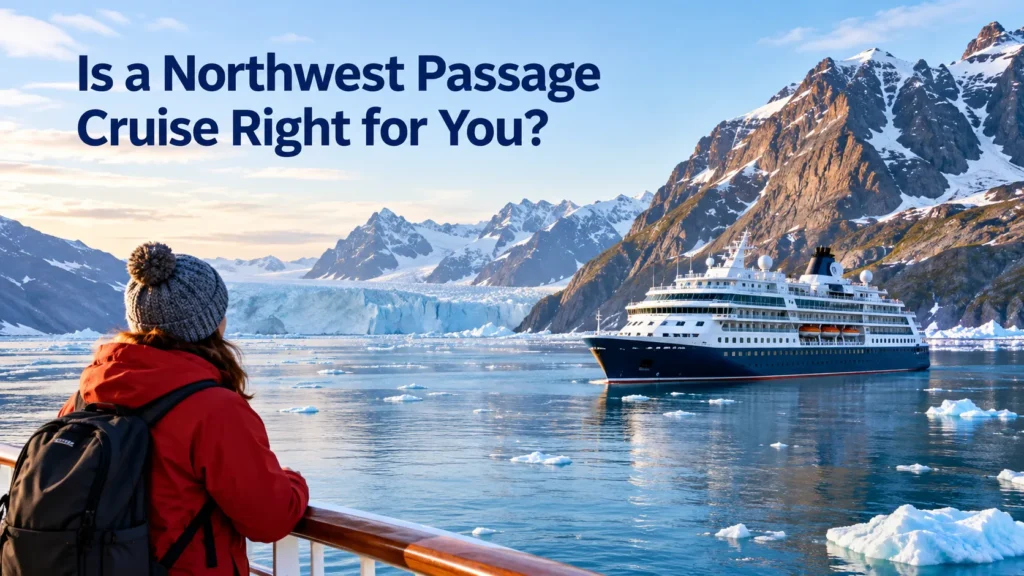
A Northwest Passage cruise makes sense for travelers who are comfortable with expedition travel.
You should expect:
- Cold weather
- Remote locations
- Flexible schedules
- Small-boat excursions
- Uneven terrain
- Changing weather
- Possible itinerary changes
- Wildlife sightings that cannot be guaranteed
In return, you get access to places that are difficult to reach independently.
You can travel through the Canadian Arctic, see icebergs and glaciers, look for polar bears and whales, visit Inuit communities and learn about the history of Arctic exploration.
The important thing is to book the trip you actually want.
If your main goal is to complete a full Northwest Passage transit, verify that before booking.
If your main goal is polar wildlife, study the route and season.
If your priority is luxury, compare cabins, facilities and inclusions.
If your priority is price, calculate the complete trip rather than comparing cruise fares alone.
And if you want a real expedition experience, pay attention to ship size, shore access and the amount of time devoted to landings and exploration.
Northwest Passage Cruise FAQs
How much does a Northwest Passage cruise cost?
There is no single price. Current published examples range from expedition cruises priced in the mid-five figures to higher-cost luxury itineraries. The route, ship, duration, cabin and inclusions all affect the final price. Current HX examples include 25-day itineraries from roughly €21,000 to €25,000 depending on the sailing and route.
How long does a Northwest Passage cruise take?
Shorter trips can last around two weeks, while longer voyages can run for three weeks or more. A full passage can take around a month according to Responsible Travel.
What is the best month for a Northwest Passage cruise?
July through September is the main period to investigate. The exact sailing season varies by operator and route. September may offer better Northern Lights opportunities, while earlier summer voyages provide long daylight and strong wildlife activity.
Can you see polar bears on a Northwest Passage cruise?
Yes, polar bears are among the wildlife travelers may encounter. But sightings aren’t guaranteed. Location, season, sea ice and animal behavior all affect what you see.
Can you see narwhals and beluga whales?
Yes. Both are possible in the Canadian Arctic, although sightings depend on the location and conditions during your sailing.
Do Northwest Passage cruises visit Inuit communities?
Some do. The communities and experiences depend on the itinerary. Cultural visits should be approached as visits to living communities, not simply as tourist stops.
Are Northwest Passage cruises luxury cruises?
Some are. Others focus more heavily on expedition activities. Compare the ship, cabin, facilities, included services and itinerary rather than assuming every Northwest Passage cruise has the same level of luxury.
Does every Northwest Passage cruise complete the full passage?
No. Some itineraries cover selected sections. Others are designed as longer transits. Check the actual route and endpoints before booking.
Is Alaska part of a Northwest Passage cruise?
Some longer routes extend toward the Beaufort Sea and northern Alaska. Alaska can therefore appear in a Northwest Passage itinerary, but the historic passage itself runs through the Canadian Arctic Archipelago.
Final Things to Check Before Booking
Before you book a Northwest Passage cruise, check five things carefully.
First, check the map.
Don’t assume the words “Northwest Passage” mean a full transit.
Second, check the ship.
Passenger capacity, expedition equipment and shore access can change the experience.
Third, check what the price includes.
Flights, hotels, transfers, meals, excursions, Wi-Fi, equipment and gratuities can differ between operators.
Fourth, check the season.
The Arctic cruise season is short, and ice conditions vary.
Finally, check the cancellation and itinerary conditions.
A Northwest Passage expedition operates in a region where the actual route can change.
That’s not a small detail buried in the terms.
It’s part of how the trip works.
For Explore Real World readers, the most useful way to think about a Northwest Passage cruise is therefore not simply as a holiday price or a cruise line comparison. Look at the relationship between the route, ship, season, activities, wildlife, culture, duration and total cost.
Once those attributes are clear, comparing the available sailings becomes much easier.