
How Much Does 5 Gallons of Water Weigh? Easy Pounds, KG, and Liters Guide

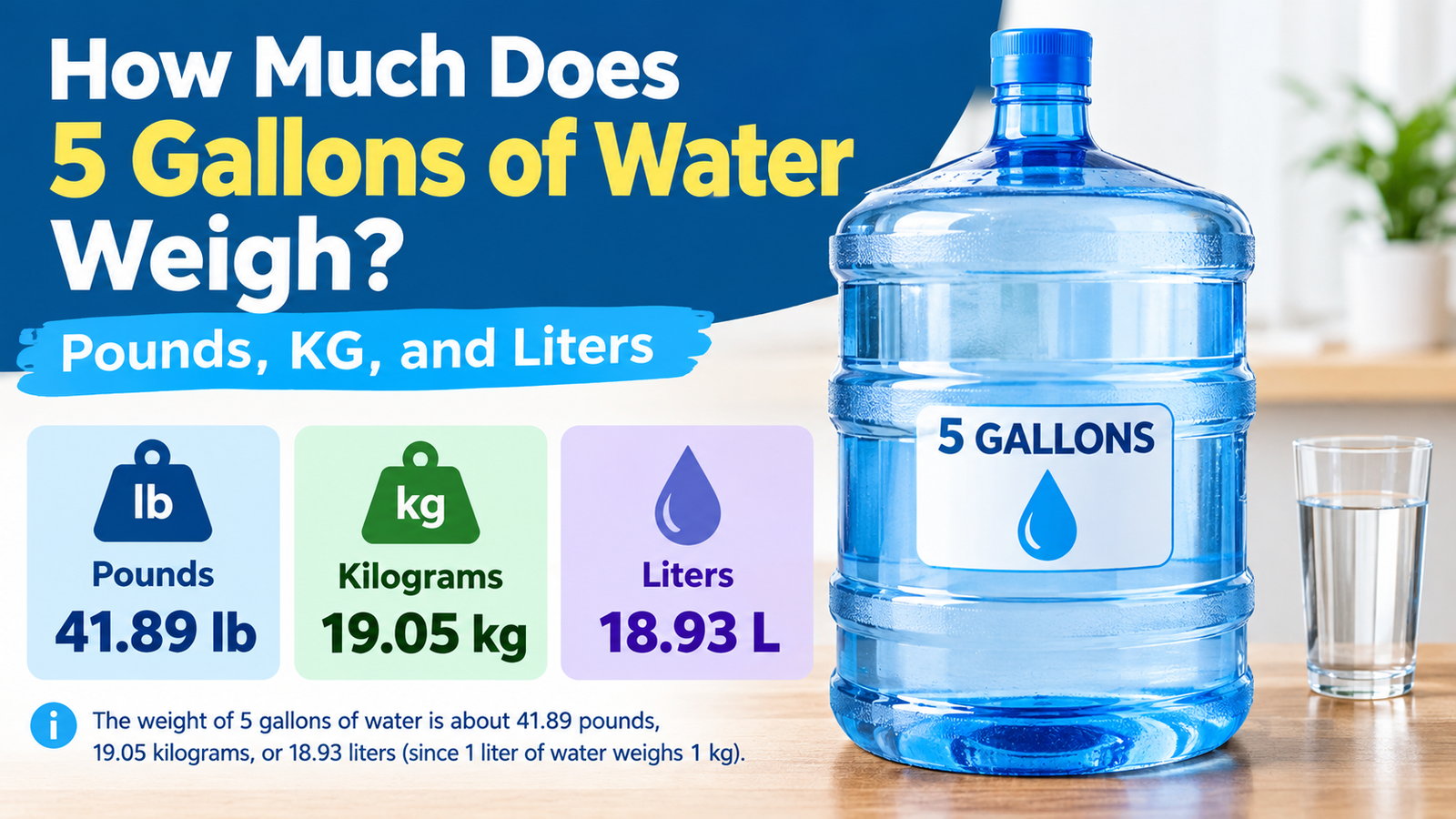
Five U.S. gallons of water weigh about 41.7 pounds at room temperature. That is roughly 18.9 kilograms. Each gallon weighs around 8.34 pounds. If you came here for one number, that is it.
Now, the gallon itself causes most of the mix-ups. A U.S. gallon holds 3.785 liters. An Imperial gallon holds 4.546 liters, which is a fair bit more. Five Imperial gallons of water weighs close to 50 pounds, not 41.7. So when two sources disagree, the first thing to check is which gallon they mean. It is usually that simple.
Temperature nudges the number as well, though barely. Water is at its heaviest near 4°C, about 39°F. Warm it up to room temperature and each gallon drops to roughly 8.33 pounds. Across five gallons, that is a fraction of a pound. One site writes 41.6, another writes 41.7, and neither is wrong. Just rounding.
One more thing people forget: the container. An empty 5-gallon jug, usually plastic, adds around 1.5 to 2.5 pounds. So the thing you pick up is closer to 43 or 44 pounds. Keep that in mind before loading a shelf, packing a car, or carrying one up a flight of stairs.
How Much Does 5 Gallons of Water Weigh?
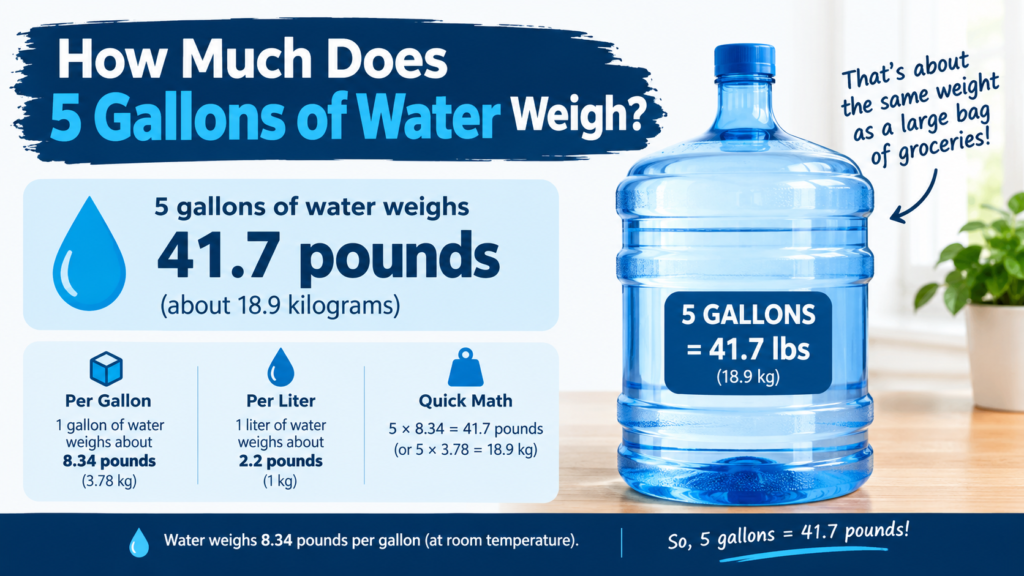
Five U.S. gallons of water weigh about 41.6 pounds (18.9 kilograms) at room temperature. A slightly rounded figure of 41.7 pounds is also commonly used. The exact number can change a little with water temperature because water density changes as temperature changes. This figure refers to the water itself, not the bucket, jug, or bottle holding it.
That distinction matters more than it may seem. A five-gallon water container is not a light object. If the empty container weighs a few pounds, the total load can be well above 41.6 pounds. Anyone carrying, storing, transporting, or lifting a full container needs to account for both the water and the container.
There is also a measurement issue. The answer above uses the U.S. gallon. A U.S. gallon contains about 3.785 liters, while an Imperial gallon used in the United Kingdom contains about 4.546 liters. Five Imperial gallons therefore hold more water and weigh more than five U.S. gallons.
How Much Does 5 Gallons of Water Weigh in Pounds?
At about 70°F (21°C), five U.S. gallons of water weighs approximately 41.6 pounds. Another common reference gives 41.7 pounds because it rounds the weight of one gallon to 8.34 pounds. The Calculator Site lists five gallons at 41.6 pounds at room temperature, while Waterdrop lists five gallons at 41.7 pounds.
The small difference is not a mistake. It comes from rounding and from the temperature used when calculating water density.
A simple everyday calculation looks like this:
5 gallons × 8.33 pounds per gallon = 41.65 pounds
Rounded to one decimal place, that becomes about 41.7 pounds. If a source uses a slightly different density value, it may report 41.6 pounds instead.
| Amount of Water | Approximate Weight |
| 1 U.S. gallon | 8.33 pounds |
| 2 U.S. gallons | 16.66 pounds |
| 3 U.S. gallons | 24.99 pounds |
| 4 U.S. gallons | 33.32 pounds |
| 5 U.S. gallons | 41.6 to 41.7 pounds |
| 10 U.S. gallons | 83.3 pounds |
For most household situations, there is no practical reason to worry about the difference between 41.6 and 41.7 pounds. The useful number to remember is about 42 pounds for five U.S. gallons of water.
How Many Kilograms and Liters Are in 5 Gallons of Water?
Five U.S. gallons equals approximately 18.93 liters. The weight is approximately 18.9 kilograms at room temperature. The Calculator Site gives 18.9 kilograms for five gallons, while its reference table lists 18.89 kilograms.
The basic conversion is:
1 U.S. gallon = 3.785 liters
Therefore:
5 × 3.785 = 18.925 liters
That is normally rounded to 18.93 liters.
Because water has a density close to 1 kilogram per liter under common conditions, 18.93 liters of water weighs close to 18.9 kilograms. The exact relationship is not perfectly fixed because water density changes with temperature. Still, 18.9 kilograms is a useful everyday figure.
| Measurement | Approximate Value |
| 5 U.S. gallons | 18.93 liters |
| Water weight | 41.6 to 41.7 pounds |
| Water weight | 18.9 kilograms |
| Water weight in ounces | About 666 ounces |
This is also why a five-gallon container can feel surprisingly heavy. Nearly 19 liters of water is a substantial amount of liquid. The container may be easy to pick up when empty, but its weight changes quickly once it is filled.
Why Does the Weight of 5 Gallons Change With Temperature?
Water does not have exactly the same density at every temperature. As temperature changes, the spacing between water molecules changes, which affects the density of a fixed volume of water.
Water reaches its greatest density at about 39.2°F (4°C). At around 70°F (21°C), the density is slightly lower. The Calculator Site uses a density of about 0.998 grams per milliliter for its room-temperature reference and gives a five-gallon weight of 41.6 pounds.
Waterdrop also notes that water density changes with temperature and gives 39.2°F (4°C) as the temperature at which water has its highest density. Its room-temperature reference is around 68°F to 72°F, where one gallon weighs about 8.34 pounds.
For everyday use, these changes are small. If someone is carrying a five-gallon jug, estimating the load at roughly 42 pounds is more useful than calculating the density to several decimal places.
Temperature becomes more important in scientific, laboratory, engineering, or industrial work. In those settings, the temperature of the water may need to be included in the calculation.
There is another detail worth knowing. Water behaves differently as it gets very close to freezing. Its density reaches a maximum around 4°C and then decreases as it approaches its freezing point. So it is too simple to say that water always gets denser as it gets colder. The temperature range matters.
How Much Does a Full 5-Gallon Water Jug Weigh?
A full five-gallon jug weighs more than 41.6 or 41.7 pounds because the container has its own weight. The 41.6-pound figure refers to the water only. The Calculator Site specifically notes that the weight of the bucket or bottle needs to be added to the water weight.
For example, suppose an empty plastic container weighs 2 pounds. Five gallons of water would add about 41.6 pounds. The combined load would then be about:
41.6 pounds of water + 2 pounds of container = 43.6 pounds total
If the empty container weighs 3 pounds, the total would be about 44.6 pounds. If it weighs 5 pounds, the total would be about 46.6 pounds.
This is one of the most common mistakes people make when discussing five-gallon water weight. They see a container labeled “5 gallons” and assume the entire filled container weighs 41.6 pounds. It does not. The label describes the container’s capacity, not its total loaded weight.
The same issue applies to storage shelves, vehicle loads, carts, water dispensers, and other equipment. If the load limit is close to 42 pounds, the weight of the container should be included before deciding whether the setup can safely hold it.
A five-gallon jug can also be awkward to carry even when the total weight is known. The shape, handle position, grip, and how far the jug must be carried all affect how manageable the load feels. The number on the scale is only part of the practical problem.
U.S. Gallons vs. Imperial Gallons
The phrase “five gallons” can cause confusion because there are two commonly encountered gallon measurements.
A U.S. gallon contains approximately 3.785 liters, or 128 U.S. fluid ounces. An Imperial gallon contains approximately 4.546 liters, or 160 Imperial fluid ounces.
That means five U.S. gallons and five Imperial gallons are not the same volume.
| Type of Gallon | One Gallon | Five Gallons | Approximate Water Weight |
| U.S. gallon | 3.785 liters | 18.93 liters | About 41.6 to 41.7 lb |
| Imperial gallon | 4.546 liters | 22.73 liters | About 50 lb |
So if a question comes from a U.S. source and asks how much five gallons of water weighs, the expected answer is generally about 41.6 pounds. If the measurement is based on the Imperial system, the answer will be higher.
This is an easy detail to miss when comparing information from websites in different countries. The word “gallon” alone does not tell you which gallon is being used.
Also view: Yourtown Prize Home: How the Draw Works
Why Knowing the Weight of 5 Gallons of Water Matters
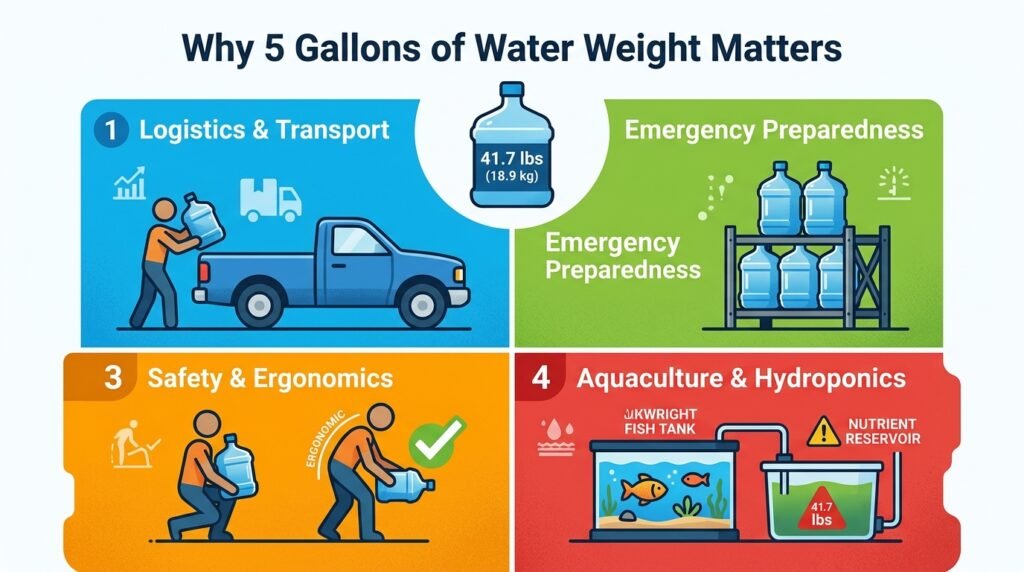
Knowing the weight of five gallons can help with everyday tasks where water needs to be moved or stored. A five-gallon jug contains almost 19 liters of water, so it can put a fairly large load on a person’s arms, a cart, a vehicle, or a shelf.
It matters when transporting water because the water weight becomes part of the total load. It also matters when storing water in a raised location. A shelf holding several containers can end up supporting much more weight than one container alone.
The same calculation can be useful for tanks, pools, irrigation systems, camping supplies, emergency water storage, and household water use. Waterdrop points out that water weight is relevant to transportation in jugs, tanks, and bottles, as well as larger applications involving water storage and treatment.
For example, two five-gallon containers hold ten gallons of water. That is about 83.3 pounds of water before the containers are counted. Three containers would contain about 15 gallons, or roughly 124.9 pounds of water.
The numbers climb quickly. That is why estimating the weight before moving several containers is a sensible step.
Another common mistake is confusing fluid ounces with weight ounces. A gallon describes liquid volume. Pounds and ounces can describe weight. The two systems are related through the density of the liquid, but they are not interchangeable measurements.
Water makes the calculation fairly easy because its density is close to 1 kilogram per liter under common conditions. Other liquids can have very different densities. Five gallons of oil, syrup, fuel, or another liquid will not necessarily weigh the same as five gallons of water.
For five U.S. gallons of water, the practical answer remains simple: expect about 41.6 to 41.7 pounds of water, or about 18.9 kilograms. Add the weight of the container if the question concerns a full jug or bucket.
If a quick estimate is all that is needed, use 42 pounds. If the calculation needs greater precision, use the water temperature and the appropriate density value. The difference is small for normal household use, but the distinction matters in precise measurements.
In short, five U.S. gallons is about 18.93 liters and weighs around 41.6 pounds at 70°F. A full five-gallon jug will weigh more because of the container. The exact water weight can vary slightly with temperature, and the answer changes considerably if the measurement refers to Imperial gallons rather than U.S. gallons. :contentReference[oaicite:10]{index=10}
FAQ:
How much does 5 gallons of water weigh?
Five U.S. gallons of water weigh about 41.6 to 41.7 pounds, or roughly 18.9 kilograms. The exact weight can vary slightly with water temperature.
How many pounds is 5 gallons of water?
Five U.S. gallons contain about 41.6 pounds of water. This does not include the weight of the jug, bucket, or other container holding the water.
How many liters are in 5 gallons of water?
Five U.S. gallons equal about 18.93 liters. This conversion uses the U.S. gallon, which is smaller than the Imperial gallon used in some countries.
Does the temperature of water change its weight?
Yes. Water density changes slightly with temperature, so the same volume of water can have a slightly different weight at different temperatures. For everyday use, 5 U.S. gallons can be treated as about 41.7 pounds.
How much does a 5-gallon water jug weigh when full?
A full 5-gallon jug contains about 41.7 pounds of water. The total weight will be higher once you add the weight of the empty jug, which depends on its material and design.
Is 5 gallons of water the same as 5 gallons of other liquids?
No. Different liquids have different densities. Five gallons of milk, oil, gasoline, or another liquid can weigh more or less than five gallons of water.