Which Is Better, the Quest 3 or the Quest 3S? A Complete Comparison

If you’re shopping for a new VR headset, you may be wondering: which is better, the Quest 3 or the Quest 3S? At first glance, the two headsets look very similar. Both run the same Quest 3 generation platform, support the same Quest apps and games, and offer wireless virtual and mixed reality experiences.
But there is one major difference that can change your entire experience: the display and lenses.
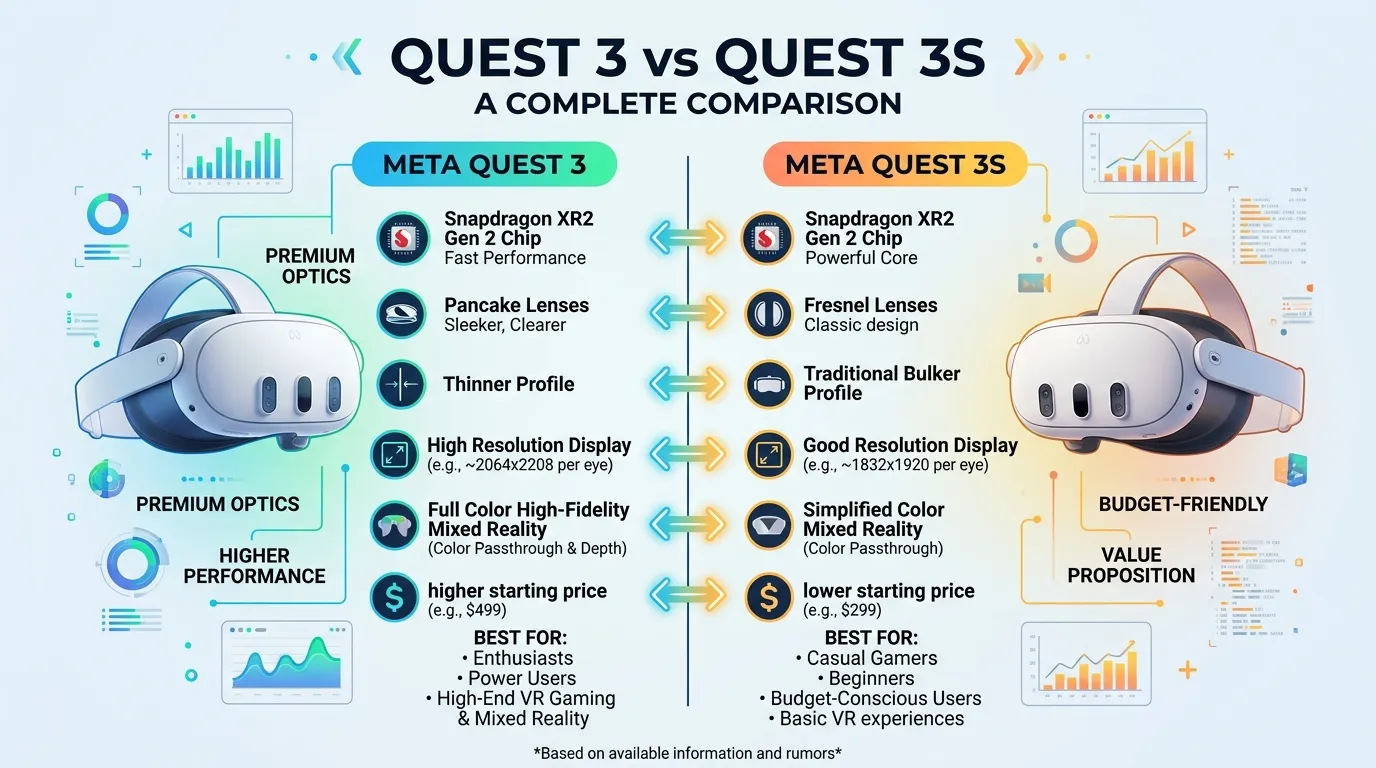
The Meta Quest 3 has higher-resolution displays and pancake lenses, while the more affordable Quest 3S uses lower-resolution displays with Fresnel-style optics. The Quest 3 also has a wider field of view and a dedicated depth sensor.
So, is the Quest 3 worth paying more for, or is the Quest 3S the smarter choice?
For most people who can afford it, the Quest 3 is the better overall headset. However, the Quest 3S can be an excellent choice for beginners who want to enter VR at a lower price.
In this guide, we’ll compare the Quest 3 vs Quest 3S across display quality, lenses, performance, mixed reality, comfort, battery life, storage, price, games, and more.
Quest 3 vs Quest 3S: Quick Comparison
Here’s a quick look at the biggest differences:
| Feature | Meta Quest 3 | Meta Quest 3S |
|---|---|---|
| Processor | Snapdragon XR2 Gen 2 | Snapdragon XR2 Gen 2 |
| RAM | 8GB | 8GB |
| Display | LCD | LCD |
| Resolution per eye | 2064 × 2208 | 1832 × 1920 |
| Optics | Pancake | Fresnel-style |
| Field of view | 110° horizontal / 96° vertical | 96° horizontal / 90° vertical |
| Refresh rate | Up to 120Hz | Up to 120Hz |
| Color passthrough | Yes | Yes |
| Depth sensor | Yes | No |
| Hand tracking | Yes | Yes |
| Touch Plus controllers | Yes | Yes |
| Wi-Fi | Wi-Fi 6E | Wi-Fi 6E |
| Battery life | Around 2 hours | Around 2.5 hours |
| Storage options | 512GB | 128GB / 256GB |
| Best for | Overall experience | First-time VR buyers |
Meta’s official device comparison confirms the display, optics, field-of-view, sensor, memory, processor, and battery differences between the two models.
What Is the Meta Quest 3?
The Meta Quest 3 is Meta’s higher-end mainstream standalone VR headset.
It can also connect to a PC for PC VR through Meta Quest Link or Air Link. Meta lists PC VR support for both the Quest 3 and Quest 3S.
The Quest 3 and Quest 3S share many of the same core features, but there are important differences in display quality, performance, and overall value. If you want another detailed breakdown of these differences, you can also read PCMag’s Meta Quest 3 vs. Meta Quest 3S comparison.
Meta says the Quest 3’s processor provides more than twice the graphics performance of the previous-generation Snapdragon GPU used in Quest 2.
What Is the Meta Quest 3S?
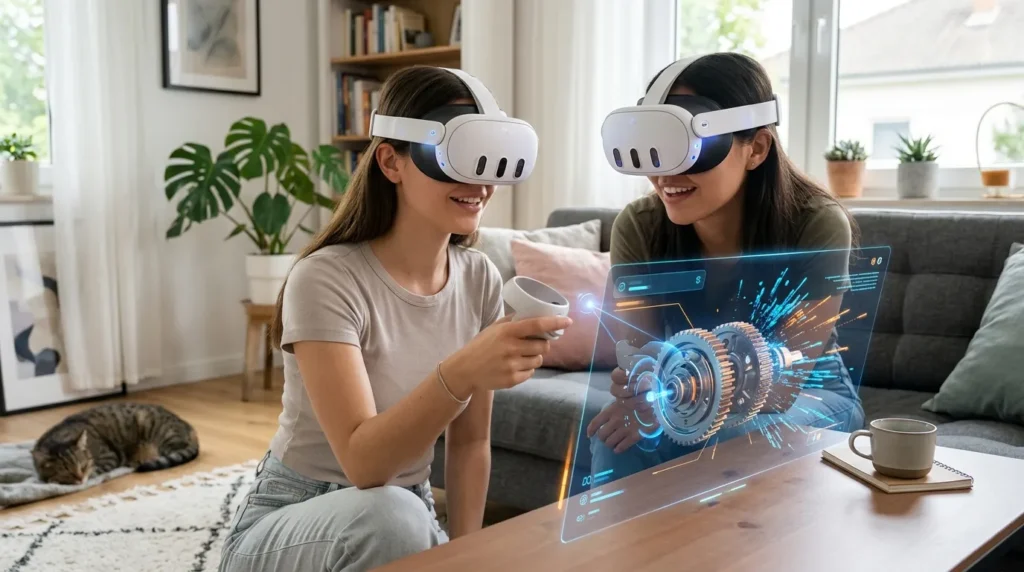
The Meta Quest 3S is the more affordable headset in the Quest 3 family.
It uses the same Snapdragon XR2 Gen 2 platform and 8GB of memory as the Quest 3. It also supports the same generation of Quest applications and games. Meta specifically describes the Quest 3S as running all Meta Quest 3 apps.
This is important.
The Quest 3S isn’t simply an older headset with a new name. It uses the same core performance platform as the Quest 3.
The main savings come from the headset’s optical and display system.
Instead of the Quest 3’s pancake lenses and higher-resolution displays, the Quest 3S uses a lower-resolution display system based on Fresnel-style optics.
That makes the Quest 3S cheaper, but it also means the visual experience isn’t as clear or as easy to adjust.
Quest 3 vs Quest 3S: Performance
When it comes to raw performance, the difference is much smaller than you might expect.
Both headsets use the Snapdragon XR2 Gen 2 platform and have 8GB of memory.
That means the Quest 3S isn’t dramatically slower than the Quest 3.
Both can run the same generation of Quest games and apps.
This is one of the strongest reasons to consider the Quest 3S.
You’re not buying a low-power headset just because you’re paying less.
Instead, you’re getting similar core processing capability with a less advanced display and optical system.
Quest 3 performance advantage
The Quest 3 can still have an advantage in some experiences because its display and optics can show more detail clearly.
But if you’re comparing the two based only on the processor, there isn’t a major gap.
Winner for raw platform performance: Tie
Quest 3 vs Quest 3S: Display Quality
This is where the Quest 3 pulls ahead.
The Quest 3 has a per-eye resolution of 2064 × 2208, while the Quest 3S has 1832 × 1920 per eye. Meta lists the Quest 3 at 25 pixels per degree compared with 20 PPD for the Quest 3S.
That difference can make text, menus, objects, and fine details look clearer on the Quest 3.
Think about reading text inside VR.
On a clearer display, letters can look sharper and easier to focus on. Fine details in games can also appear more defined.
Display winner: Quest 3
Quest 3 vs Quest 3S: Pancake vs Fresnel Lenses
This may be the most important difference of all.
The Quest 3 uses pancake optics.
The Quest 3S uses a different lens design based on the traditional Fresnel approach.
Why does this matter?
With the Quest 3, the image remains clear across a larger portion of the lens. You don’t have to position your eyes perfectly to find a small sweet spot.
This makes everyday VR feel more natural.
The Quest 3S can still look good, but you’ll notice more limitations when moving your eyes around instead of moving your entire head.
Why pancake lenses matter
Imagine reading a large virtual screen.
With the Quest 3, you can look toward different parts of the screen with your eyes and still maintain good clarity.
With the Quest 3S, you may find yourself moving your head more to bring text or details into the clearest part of the lens.
This is one reason the Quest 3 feels like a more premium headset.
Meta specifically lists pancake optics as a Quest 3 feature, while its comparison lists different optics for the Quest 3S.
Lens winner: Quest 3
Quest 3 vs Quest 3S: Field of View
The Quest 3 also has a wider field of view.
Meta lists:
- Quest 3: 110° horizontal and 96° vertical
- Quest 3S: 96° horizontal and 90° vertical
A wider field of view can make VR feel more immersive because more of the virtual environment is visible around you.
The difference isn’t the same as jumping from a tiny screen to a giant cinema screen, but it contributes to the overall experience.
When you’re playing a fast-moving game, exploring a virtual world, or simply looking around a virtual environment, the Quest 3 can feel more open.
Field-of-view winner: Quest 3
Quest 3 vs Quest 3S: Mixed Reality
Both headsets support color passthrough and mixed reality.
This means you can see your real surroundings through the headset’s cameras while virtual objects are placed around your physical environment.
Both models use a similar color passthrough camera system, but the Quest 3 has a dedicated depth sensor. Meta lists the Quest 3 with a 4MP stereoscopic color passthrough system plus a depth sensor, while the Quest 3S has stereoscopic color passthrough without the dedicated depth sensor.
The depth sensor helps the Quest 3 understand your physical environment.
That can make room setup and spatial awareness easier.
The Quest 3S isn’t missing mixed reality. It still offers strong mixed-reality capabilities.
In fact, Meta says the Quest 3S has the same mixed-reality capabilities as the Quest 3 at its lower starting price.
Mixed-reality winner: Quest 3
Quest 3 vs Quest 3S: Controllers and Tracking
Both headsets come with Meta’s Touch Plus controllers.
These controllers use tracking without the large outer tracking rings found on older Quest controllers.
Meta says the Touch Plus controllers use hybrid computer-vision and machine-learning tracking and include TruTouch haptics.
Both headsets also support hand tracking.
So, you don’t lose the modern controller experience by buying the cheaper Quest 3S.
Controller winner: Tie
Quest 3 vs Quest 3S: Refresh Rate
Both headsets support refresh rates up to 120Hz.
A higher refresh rate can make movement feel smoother and can be especially useful in VR, where smooth motion contributes to comfort and immersion.
Interestingly, Meta’s current developer documentation says the Quest 3 can support display refresh rates above 120Hz, including up to 207Hz at full resolution through standard APIs and up to 240Hz in developer mode with display scaling. The Quest 3S does not support refresh rates above 120Hz.
For normal consumers, however, 120Hz is the practical comparison.
Refresh-rate winner: Quest 3
Quest 3 vs Quest 3S: Battery Life
This is one area where the cheaper headset has an advantage on paper.
Meta’s device comparison lists approximately:
- Quest 3: 2 hours
- Quest 3S: 2.5 hours
That doesn’t mean you’ll always get exactly those numbers.
Battery life changes depending on the game, brightness, wireless use, settings, and other factors.
Still, if you’re looking at the official approximate figures, the Quest 3S lasts longer.
The difference isn’t huge, but it could matter if you regularly have longer VR sessions.
Battery winner: Quest 3S
Quest 3 vs Quest 3S: Storage
Storage is another important difference.
Meta currently lists the Quest 3 with 512GB of storage, while the Quest 3S is available in 128GB and 256GB versions. Meta’s current product pages list the Quest 3 at $599.99 for 512GB and the Quest 3S at $349.99 for 128GB or $449.99 for 256GB.
This makes the Quest 3 particularly attractive if you plan to build a large VR library.
Games can take up a surprising amount of space.
You may eventually find yourself deleting older games to make room for new ones on a smaller headset.
With 512GB, you have considerably more room.
Storage winner: Quest 3
Quest 3 vs Quest 3S: Price
Price is where the Quest 3S becomes very attractive.
Meta’s current listed U.S. prices are:
- Quest 3S 128GB: $349.99
- Quest 3S 256GB: $449.99
- Quest 3 512GB: $599.99
That creates a significant price gap between the models.
The 128GB Quest 3S is $250 less than the 512GB Quest 3.
For someone who has never owned a VR headset, that lower price can make the Quest 3S much easier to justify.
You can spend the money you save on games, accessories, a carrying case, or a better head strap.
Price winner: Quest 3S
Quest 3 vs Quest 3S: Which Is Better for Gaming?
The Quest 3 also offers a highly portable gaming experience, making it an interesting option for players who enjoy gaming without being tied to a traditional setup. If you’re comparing other portable gaming devices, check out our Legion Go S vs Steam Deck OLED comparison.
But the Quest 3 provides a better gaming experience overall.
Why?
The higher-resolution display and pancake lenses make the game world easier to see clearly.
Small objects can be easier to identify. Text can be easier to read. Distant details can look sharper.
The wider field of view also adds to immersion.
If you plan to spend hundreds of hours in VR, these differences become more important.
Gaming winner: Quest 3
Quest 3 vs Quest 3S for Beginners
This is where the decision gets more difficult.
If you’re buying your first VR headset, the Quest 3S makes a lot of sense.
You get:
- Modern Quest performance
- Color mixed reality
- Touch Plus controllers
- Hand tracking
- Access to Quest 3 apps
- Lower entry price
For someone who isn’t sure whether they will use VR regularly, spending less money is reasonable.
But there’s another way to look at it.
If you already know you enjoy VR and expect to use your headset frequently, buying the Quest 3 from the start may save you from wanting an upgrade later.
Beginner winner: Quest 3S for value, Quest 3 for the full experience
Quest 3 vs Quest 3S for Movies and Media
Both headsets can be used for watching movies, videos, streaming content, and other media.
But the Quest 3’s display and lenses give it an advantage.
The higher resolution and pancake optics can make virtual cinema screens more enjoyable.
If you plan to spend a lot of time watching movies or using large virtual screens, the Quest 3 is the better choice.
The Quest 3S can still work well for occasional media use, especially if price is your main concern.
Media winner: Quest 3
Quest 3 vs Quest 3S for Fitness
Both headsets can be used for VR fitness games and exercise apps.
The Quest 3S may have a small advantage if you care about its slightly longer official battery estimate.
But comfort is more complicated.
The weight and balance of a VR headset depend not only on the headset itself but also on the facial interface and head strap you use.
For long fitness sessions, investing in a comfortable replacement strap may matter more than the difference between these two models.
Fitness winner: Tie
Is the Quest 3 Worth the Extra Money?
For many users, yes.
The extra money gets you several improvements at once:
- Higher resolution
- Pancake optics
- Wider field of view
- Depth sensor
- More storage
- Better display hardware
- Greater refresh-rate flexibility
The processor isn’t the main reason to buy the Quest 3.
The biggest reason is the quality of the experience you see through the lenses.
That’s an important distinction.
The Quest 3S can run the same generation of games, but the Quest 3 makes those games easier and more enjoyable to look at.
If you’re going to use VR several times a week, the better optics can be worth paying for.
Is the Quest 3S Worth Buying?
Yes.
The Quest 3S is especially attractive for people who want to enter VR without spending $600.
You get the same basic Quest 3 generation platform, access to the same current app ecosystem, color mixed reality, modern controllers, and wireless standalone VR.
The biggest sacrifices are the display resolution, optics, field of view, storage options, and depth sensor.
If you mainly want to play VR games and don’t care as much about having the sharpest image, the Quest 3S can be a very good starting point.
Quest 3 vs Quest 3S: Pros and Cons
Meta Quest 3 Pros
- Higher-resolution display
- Pancake lenses
- Wider field of view
- Better visual clarity
- 512GB storage
- Depth sensor
- Same powerful XR2 Gen 2 platform
- Supports modern Quest games
- Better long-term choice for frequent users
- More premium overall experience
Meta Quest 3 Cons
- Higher price
- Shorter approximate battery life
- More expensive if you’re unsure about VR
- Some benefits may be less noticeable to casual users
Meta Quest 3S Pros
- Much lower starting price
- Same Snapdragon XR2 Gen 2 platform
- 8GB memory
- Color mixed reality
- Touch Plus controllers
- Access to Quest 3 apps
- Slightly longer approximate battery life
- Great entry point for VR
Meta Quest 3S Cons
- Lower display resolution
- Less advanced optics
- Smaller field of view
- No dedicated depth sensor
- Less storage on available models
- More limited visual clarity
Quest 3 vs Quest 3S: Who Should Buy Which?
Buy the Quest 3 if:
- You want the best overall experience.
- You care about visual clarity.
- You play VR regularly.
- You want pancake lenses.
- You want more storage.
- You watch movies or use virtual screens.
- You want the widest field of view.
- You’re upgrading from an older Quest headset.
- You plan to keep the headset for several years.
Buy the Quest 3S if:
- This is your first VR headset.
- You want to spend less.
- You’re not sure how often you’ll use VR.
- You mainly want to play games.
- You don’t mind lower display resolution.
- You want modern Quest performance without paying for premium optics.
- You’d rather spend the savings on games and accessories.
Quest 3 vs Quest 3S: Which One Has Better Value?
This depends on what you mean by value.
If value means the lowest price for modern Quest performance, the Quest 3S wins.
If value means the best experience for the money over several years, the Quest 3 has a stronger case.
The Quest 3S gives you the essential Quest experience at a lower cost.
The Quest 3 gives you that same core platform with a much better visual system.
For a person who plans to use VR frequently, the Quest 3’s pancake lenses alone can make the additional cost easier to justify.
Frequently Asked Questions
Which is better, the Quest 3 or the Quest 3S?
The Quest 3 is better overall because it has higher-resolution displays, pancake lenses, a wider field of view, a depth sensor, and more storage. The Quest 3S is better if your priority is getting modern Quest performance at a lower price.
Is Quest 3S as powerful as Quest 3?
Yes, both use the Snapdragon XR2 Gen 2 platform and 8GB of memory. The main differences are in the display, optics, field of view, depth sensor, and storage.
Does Quest 3S have better battery life than Quest 3?
Meta’s published comparison estimates around 2.5 hours for Quest 3S and around 2 hours for Quest 3. Actual battery life varies depending on use.
Does Quest 3 have better graphics than Quest 3S?
The two headsets use the same core processor, so the raw platform performance is very similar. However, the Quest 3 has a higher-resolution display and better optics, which makes games look clearer and more detailed.
Does Quest 3S have pancake lenses?
No. The Quest 3 uses pancake optics, while the Quest 3S uses a different optical design. This is one of the biggest reasons the Quest 3 provides a clearer and more flexible viewing experience.
Can Quest 3 and Quest 3S play the same games?
Both headsets support the Quest 3 generation of applications, and Meta says the Quest 3S runs all Meta Quest 3 apps.
Is Quest 3S good for beginners?
Yes. Its lower price makes it an attractive first VR headset, especially if you’re not sure how much you’ll use VR.
Is Quest 3 worth it over Quest 3S?
For frequent VR users, the Quest 3 is generally worth the extra cost because of its pancake lenses, higher resolution, wider field of view, depth sensor, and larger storage capacity.
Final Verdict: Quest 3 or Quest 3S?
So, which is better, the Quest 3 or the Quest 3S?
For the best overall VR experience, choose the Quest 3.
Its biggest advantage isn’t simply processing power. Both headsets use the same Snapdragon XR2 Gen 2 platform and 8GB of memory. The real difference is what you see and how easily you can see it.
The Quest 3’s higher-resolution displays, pancake lenses, wider field of view, depth sensor, and 512GB storage make it the stronger choice for people who expect to spend a lot of time in VR.
The Quest 3S is the better budget choice.
At $349.99 for the 128GB model, it offers a much cheaper way into modern standalone VR while keeping the same core processor platform and access to Quest 3 apps.
Our overall pick: Meta Quest 3
Best budget pick: Meta Quest 3S
If you can comfortably afford the Quest 3 and plan to use VR regularly, we’d choose the Quest 3. The pancake lenses and sharper display are the kind of improvements you’ll notice every time you put the headset on.
But if you’re new to VR, have a tighter budget, or simply want to see what virtual reality is all about, the Quest 3S remains a smart entry point.
In short: Quest 3S saves you money; Quest 3 gives you the better experience.