Little Gem Magnolia Growth Rate: How Fast Does It Grow?

If you’re thinking about planting a Little Gem magnolia, one of the first questions you may have is: How fast does it grow? The answer is useful when deciding where to plant this evergreen tree, how much space to leave around it, and how long you’ll wait for it to reach a useful landscape size.
The Little Gem magnolia (Magnolia grandiflora ‘Little Gem’) is a compact cultivar of Southern magnolia. It grows more slowly than the standard Southern magnolia, but “Little Gem” does not mean tiny. Depending on the source and growing conditions, mature plants are commonly described as roughly 15–25 feet tall, with some established specimens capable of becoming considerably larger.
So, what should you expect from the Little Gem magnolia growth rate? In this guide, we’ll look at annual growth, mature size, flowering, soil and sunlight requirements, watering, fertilizer, and the factors that determine how quickly your tree develops.
Little Gem Magnolia Growth Rate at a Glance
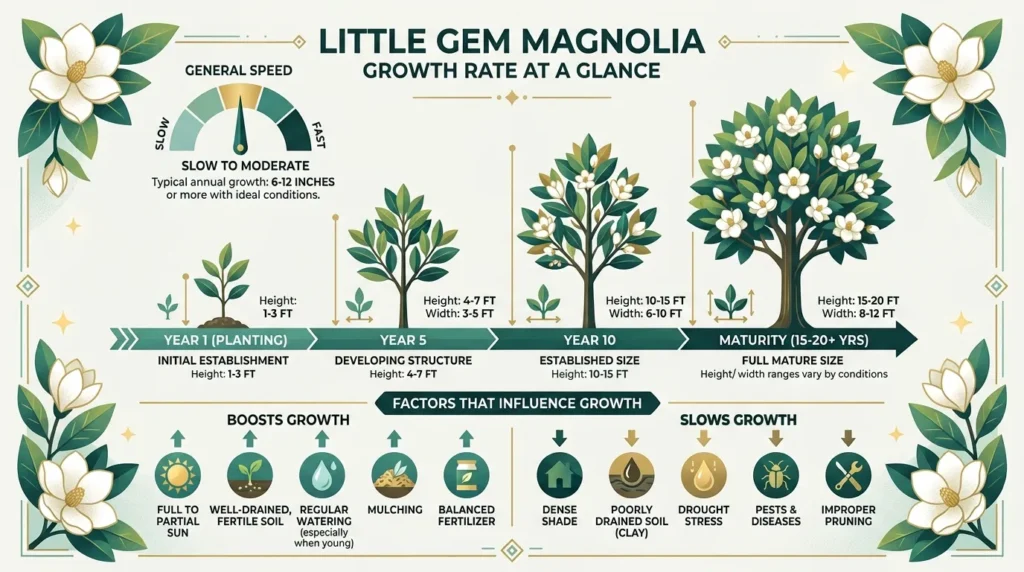
Little Gem is generally classified as a slow-growing tree, although some horticultural references describe its growth as slow to medium. North Carolina State University’s Plant Toolbox lists its growth rate as slow, while the University of Georgia describes it as having a medium growth rate.
A Coastal Carolina University Arboretum reference provides a more specific figure, stating that Little Gem grows less than 12 inches annually and typically reaches about 15–20 feet tall with a 7–10-foot spread, flowering in as little as 2–3 years. Virginia Tech’s urban tree data lists an annual height-growth range of approximately 1–2 feet for Magnolia grandiflora ‘Little Gem’ under its listed conditions.
That difference is important. There isn’t one guaranteed annual growth figure for every Little Gem magnolia.
| Growth characteristic | Typical expectation |
|---|---|
| Growth classification | Slow to slow-medium |
| Annual growth | Often around 1 foot, potentially more under favorable conditions |
| Mature height | Commonly about 15–25 feet |
| Mature width | Commonly about 8–15 feet |
| First flowering | Often around 2–3 years old |
| Foliage | Evergreen |
| Best light | Full sun to partial shade |
| Soil | Moist, fertile, well-drained soil |
Published mature-size estimates vary because trees respond differently to climate, soil, irrigation, planting location, and care.
How Many Inches Does a Little Gem Magnolia Grow Each Year?
A practical expectation is around 1 foot of new height per year, although growth can be slower or faster.
Coastal Carolina University’s Arboretum states that Little Gem grows less than 12 inches annually. Virginia Tech’s data gives a broader annual height-growth range of 1–2 feet. These figures show why it is better to think of the growth rate as a range rather than a fixed number.
For example, a healthy young tree planted in a warm climate with adequate moisture and good soil may put on more growth than a tree planted in compacted soil or exposed to drought.
A useful way to think about it is:
Slow growth does not mean no growth.
A Little Gem magnolia may take several years to become a substantial landscape tree, but it can still establish a dense canopy and begin flowering while relatively young.
How Long Does a Little Gem Magnolia Take to Reach Full Size?
There isn’t a precise number of years because mature size varies considerably among plants and growing conditions.
North Carolina State University describes Little Gem as typically reaching 15–20 feet, while another university source notes that it can reach around 25–30 feet. Older University of Florida information gives an even larger potential size under favorable conditions.
This variation is one reason you shouldn’t plant Little Gem in a location based on the assumption that it will remain a miniature tree.
The University of Florida specifically warns that although Little Gem is smaller than standard Southern magnolia, it is not a small tree and can eventually become too large for a narrow planting location.
A simple growth timeline
The following is a general illustration rather than a guaranteed growth schedule:
| Age | Possible development |
|---|---|
| Year 1 | Establishes roots and adapts to its location |
| Year 2 | Stronger shoots and increasing foliage |
| Year 2–3 | May begin flowering |
| Years 3–5 | Noticeable increase in height and canopy |
| Years 5–10 | Becomes a more substantial landscape tree |
| 10+ years | Continues developing toward its mature size |
The flowering timeline is more predictable than the height timeline. Multiple extension sources report that Little Gem can flower at only 2–3 years old, sometimes when the tree is only a few feet tall.
What Factors Affect Little Gem Magnolia Growth Rate?
The difference between a slow-growing tree and a healthy, steadily developing tree often comes down to its growing conditions.
1. Sunlight
Little Gem performs well in full sun to partial shade. North Carolina State University recommends full sun or partial shade, while the University of Florida notes that Southern magnolia thrives in full sun and warm conditions once established.
For the strongest growth, choose a location that receives plenty of direct sunlight.
More light generally means more energy available for photosynthesis and canopy development.
However, a newly planted tree may need some protection if your climate has extreme heat, especially while its root system is becoming established.
2. Soil Quality
Soil has a major influence on root development.
Little Gem prefers moist, organically rich, well-drained soil. North Carolina State University notes that it generally does not tolerate extreme wet or dry soil conditions well.
The goal isn’t simply to keep the soil wet.
The roots need both:
- Adequate moisture
- Good drainage
Constantly saturated soil can create problems for roots, while very dry soil can slow growth and cause stress.
3. Water
Water is especially important during establishment.
A young Little Gem magnolia needs consistent moisture while its root system develops. Once established, Southern magnolia is better able to handle periods of stress, but prolonged drought can still reduce growth.
Instead of watering a little every day, focus on maintaining appropriate soil moisture around the root zone.
A layer of organic mulch can also help reduce evaporation and moderate soil temperature.
Keep mulch away from direct contact with the trunk.
4. Fertilizer
Little Gem does not need excessive fertilizer simply because you want it to grow faster.
The University of Florida notes that many growers find Little Gem requires more fertilizer than some other magnolias to maintain a full canopy.
However, fertilizer should not be treated as a shortcut to rapid growth.
If the soil already provides adequate nutrients, excessive fertilizer can create problems rather than producing a healthier tree.
A soil test can help determine whether nutrients are lacking.
5. Climate
Climate can make a major difference in growth.
Little Gem is generally suited to warm climates and is commonly listed for USDA Zones 7–9, although hardiness descriptions vary somewhat by source.
In a warm growing season with sufficient moisture, a tree may produce stronger annual growth than one exposed to cold winters or repeated environmental stress.
If you’re growing Little Gem outside the regions where it is commonly cultivated, local climate becomes particularly important.
Does Little Gem Magnolia Grow Faster in the Ground or a Pot?
Little Gem can be grown in containers, and the University of Florida lists container and above-ground planter use among its landscape applications.
However, container-grown trees usually have less room for root development than trees planted directly in the ground.
A container can therefore restrict the eventual size of the plant.
If your goal is to grow a large specimen as quickly as practical, planting it in a suitable location in the ground will generally provide more room for root development.
If keeping potted saplings on sunny patios or balconies, use stable plant stands and avoid placing heavy containers where they could be knocked over.
How to Make a Little Gem Magnolia Grow Faster
You can’t completely change the natural growth habit of a cultivar, but you can remove conditions that slow it down.
Give it adequate sunlight
Choose a location with plenty of direct sunlight while considering the climate and heat exposure.
Improve poor soil
If the soil is compacted or drains poorly, correct the underlying problem before expecting strong growth.
Maintain consistent moisture
Don’t allow a newly planted tree to experience repeated severe drought.
Add organic mulch
A suitable mulch layer can help retain soil moisture and moderate temperature.
Avoid unnecessary pruning
Little Gem naturally develops an upright, compact form. The University of Florida notes that it needs little pruning to develop a strong structure.
Heavy pruning can remove growing tissue that the tree could otherwise use for canopy development.
Don’t overfertilize
More fertilizer does not automatically mean more healthy growth.
If nutrient deficiencies are suspected, test the soil before applying large amounts of fertilizer.
How Fast Does Little Gem Magnolia Grow Compared With Southern Magnolia?
Little Gem is a cultivar of Southern magnolia (Magnolia grandiflora), but it is smaller and generally slower growing than many standard forms of the species. The University of Florida describes Little Gem as slower-growing than other magnolia cultivars.
The difference becomes especially noticeable when comparing mature size.
A standard Southern magnolia can become a very large tree, while Little Gem was selected for a more compact form.
| Feature | Little Gem Magnolia | Standard Southern Magnolia |
|---|---|---|
| Scientific name | Magnolia grandiflora ‘Little Gem’ | Magnolia grandiflora |
| Growth | Slow to medium | Often faster |
| Mature size | Usually much smaller | Can become very large |
| Form | Upright, compact | Large, broad tree |
| Evergreen | Yes | Yes |
| Flowering age | Often 2–3 years | Usually later |
| Best use | Smaller gardens, screens, specimens | Large landscapes |
The key point is that Little Gem is smaller, not necessarily tiny.
When Does Little Gem Magnolia Start Flowering?
One of the attractive features of Little Gem is that it can flower at a young age.
Several university sources report flowering at around two to three years old. The University of Florida notes that flowers can appear when the tree is only three or four feet tall.
That makes Little Gem different from standard Southern magnolia, which can take considerably longer to flower.
Its flowers are large, white, fragrant, and visually striking against the dark evergreen foliage.
So even while the tree is still relatively small, it can already provide much of the ornamental appeal people want from a magnolia.
Is Little Gem Magnolia Really a Dwarf Tree?
This is where the name can be misleading.
Little Gem is often described as a dwarf or compact Southern magnolia because it is much smaller than the standard species.
But it can still reach 15–25 feet or more, depending on conditions and the source used.
The University of Florida makes the point clearly: Little Gem is smaller than standard Southern magnolia, but it should not be treated as a genuinely small tree when planning a landscape.
Avoid planting mature magnolias directly beneath eaves or close to structures, where heavy branches can scrape siding, gutters, and roofing over time.
- Narrow sidewalks
- Small patios
- Building foundations
- Rooflines
- Utility infrastructure
- Tight property boundaries
Give the tree room to mature.
Why Is My Little Gem Magnolia Growing Slowly?
If your tree is growing much more slowly than expected, don’t assume that the cultivar is the problem.
Check its growing conditions first.
Common causes include:
Too little sunlight:
Heavy shade can reduce photosynthesis and limit growth.
Poor drainage:
Constantly wet soil can stress the root system.
Drought:
Repeated periods of dry soil can slow shoot development.
Root disturbance:
Newly planted or transplanted trees often spend time establishing roots before producing strong top growth.
Nutrient deficiency:
Poor soil fertility can limit development.
Cold or unsuitable climate:
Temperature stress can shorten the growing season and reduce growth.
Competition:
Grass, shrubs, and nearby trees can compete for water and nutrients.
Remember that Little Gem is naturally a slower-growing magnolia. Gardeners and landscape designers admire its dense, glossy foliage for its year-round interest and screening value.
How Much Space Does a Little Gem Magnolia Need?
Planning for mature size is more important than its size when you buy it.
North Carolina State University lists a typical height of 15–20 feet and a width of 8–10 feet. Other university sources give mature dimensions closer to 20–25 feet tall and 10–15 feet wide, while some older University of Florida information gives a larger potential size.
Because published estimates vary, it’s sensible to give the tree more space rather than planting based on the smallest figure.
If you’re creating a hedge or privacy screen, you can plant several specimens with appropriate spacing. If you’re growing a specimen tree, give it enough room to develop its natural form.
Is Little Gem Magnolia Worth Growing?
For many gardens, yes.
Little Gem combines several desirable qualities:
- Evergreen foliage
- Fragrant white flowers
- Compact form compared with standard Southern magnolia
- Relatively early flowering
- Attractive glossy leaves
- Upright growth
- Suitability for specimen and screening uses
Its main limitation is that it isn’t as small as the name suggests.
If you have a small courtyard where a 20-foot tree would eventually be a problem, Little Gem may still be too large. But its evergreen elegance makes it a staple specimen tree in luxury landscaped gardens and major architectural builds like the Yourtown prize home.
Frequently Asked Questions About Little Gem Magnolia Growth Rate
How fast does Little Gem magnolia grow?
Little Gem is generally considered slow-growing, although some sources classify it as slow to medium. A practical expectation is around 1 foot of annual height growth, with actual growth varying according to climate, soil, water, sunlight, and establishment.
How tall will a Little Gem magnolia get?
A commonly cited mature height is around 15–25 feet, although some established trees can become larger. Because estimates vary between sources, plan for the larger potential size when choosing a planting location.
How wide does Little Gem magnolia get?
Common estimates range from approximately 8–15 feet wide, depending on growing conditions and the source.
How long does it take Little Gem magnolia to flower?
Little Gem can flower when it is only 2–3 years old, sometimes while the tree is still only a few feet tall.
Can I keep Little Gem magnolia small?
You can manage its size with pruning, but regular heavy pruning is not ideal. It’s better to choose an appropriate planting location and allow the tree to develop naturally.
Does Little Gem magnolia need full sun?
It grows well in full sun and can also tolerate partial shade. A sunny location is generally preferable for strong growth and flowering.
Is Little Gem magnolia suitable for a small garden?
It depends on what you mean by “small.” Although it is compact compared with standard Southern magnolia, it can still become a 15–25-foot tree or larger. Make sure the mature canopy has enough space.
Final Thoughts on Little Gem Magnolia Growth Rate
The Little Gem magnolia growth rate is best described as slow to moderate rather than fast. A reasonable planning figure is around 1 foot of height growth per year, although some trees can grow more quickly under favorable conditions. Published figures vary, so your local climate and growing conditions matter.
The good news is that Little Gem doesn’t need to become huge before it starts looking attractive. It can produce its characteristic fragrant white flowers at only two or three years old, while its evergreen foliage provides year-round interest.
The most important thing to remember is that Little Gem is compact relative to Southern magnolia, not miniature. Give it adequate sunlight, moisture, fertile well-drained soil, and enough room for its mature canopy, and you can expect steady development over the years.
If you’re planting one today, think beyond its current nursery size. The small tree in the garden center may eventually become a substantial evergreen specimen—and that’s part of the appeal of Little Gem magnolia.