Creatures of Sonaria COS Trade Values: Complete Trading Guide

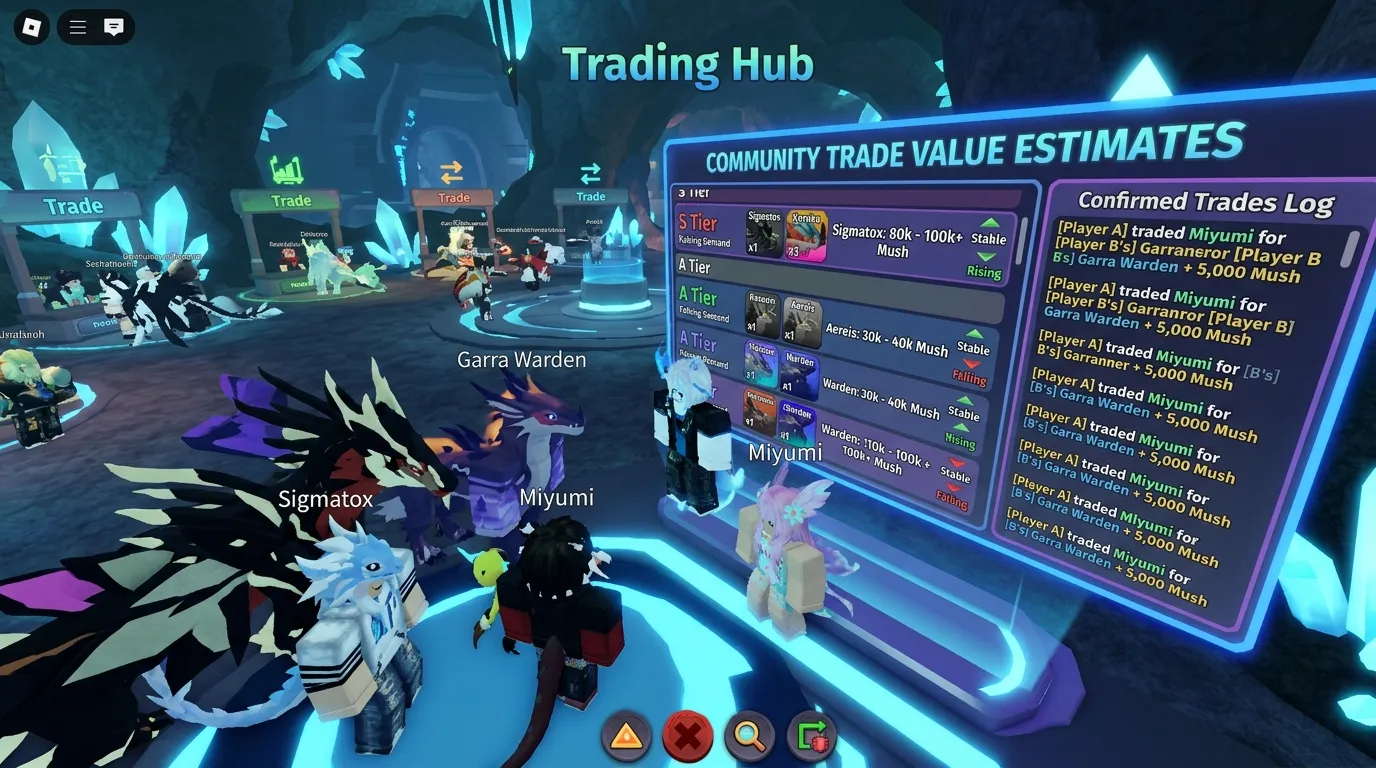
If you trade in Creatures of Sonaria, knowing an item’s current trade value can save you from making a bad deal. The problem is that COS prices are not fixed. They can change when player demand changes, when an event ends, when an item becomes harder to obtain, or when a new creature gets added.
That is why a Roblox Creatures of Sonaria value list is useful. It gives you a starting point before you make an offer. You can check the estimated Mush value any creature, look at its demand, and then compare that information with recent player trades.
There is one thing to keep in mind, though. A value list is usually an estimate. It is not a guaranteed price that every player must accept. Current market activity still matters.
What Is a Roblox Creatures of Sonaria Value List?
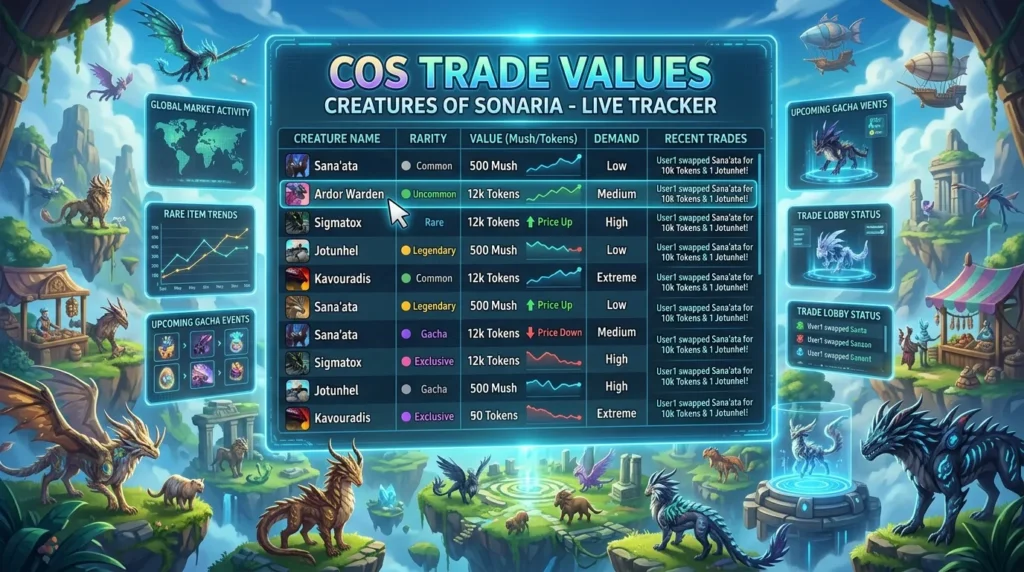
A Roblox Creatures of Sonaria value list is a reference that shows estimated trading prices for creatures and other tradeable items in the game.
Depending on the source, a list may include creatures, tokens, plushies, palettes, materials, and other items. Some lists also show demand alongside the estimated price.
This makes the list easier to use because price alone does not explain everything.
For example, a creature could have an estimated value of 30,000 Mush but have low demand. Another creature could be listed at 25,000 Mush with high demand. The second creature may be easier to trade because more players are looking for it.
Current value guides use this type of price-and-demand format. Driffle’s September 2026 guide, for example, lists creature names, estimated value ranges, and demand levels.
What Are COS Trade Values?
Creatures of Sonaria COS trade values are estimated prices players use when comparing items during trades.
Mush is the main currency used in these comparisons, but trades can include much more than Mush. Players can exchange creatures, tokens, plushies, palettes, materials, and other items.
A trade value does not mean that an item can always be sold for that exact amount.
Suppose a creature is listed at 20k to 25k Mush. One player might offer 20k. Another might offer 23k. A player who really wants the creature might offer more.
So when using a Roblox Creatures of Sonaria value list, think of the number as a reference range rather than a guaranteed selling price.
What Is Mush in Creatures of Sonaria?
Mush is the main currency players use when discussing COS trades.
Because many creature values are stated in Mush, understanding the currency makes value lists easier to read.
If a creature is listed at 10k, that means the estimated trade value is around 10,000 Mush. If another creature is listed at 100k, there is a large difference between the two markets.
For expensive creatures, even a small percentage difference can mean thousands of Mush. That is one reason players should check the current value before making a major trade.
Why Do Players Use a COS Value List?
Players use a COS value list to avoid guessing.
Without a reference, a newer trader may see a rare creature and assume it is worth a huge amount. Another player may make an offer that sounds reasonable but is far below the current market.
A value list gives you a starting point.
It can help with:
- Checking creature prices
- Comparing trade offers
- Finding high-demand items
- Checking token values
- Pricing plushies
- Comparing limited creatures
- Reviewing older and newer prices
- Preparing before entering a trade
Community discussions show that players often look for reliable value information because different sources can give different prices. A 2026 Fandom discussion also mentions community resources that include value lists and WFL calculators.
Current Creatures of Sonaria Value List
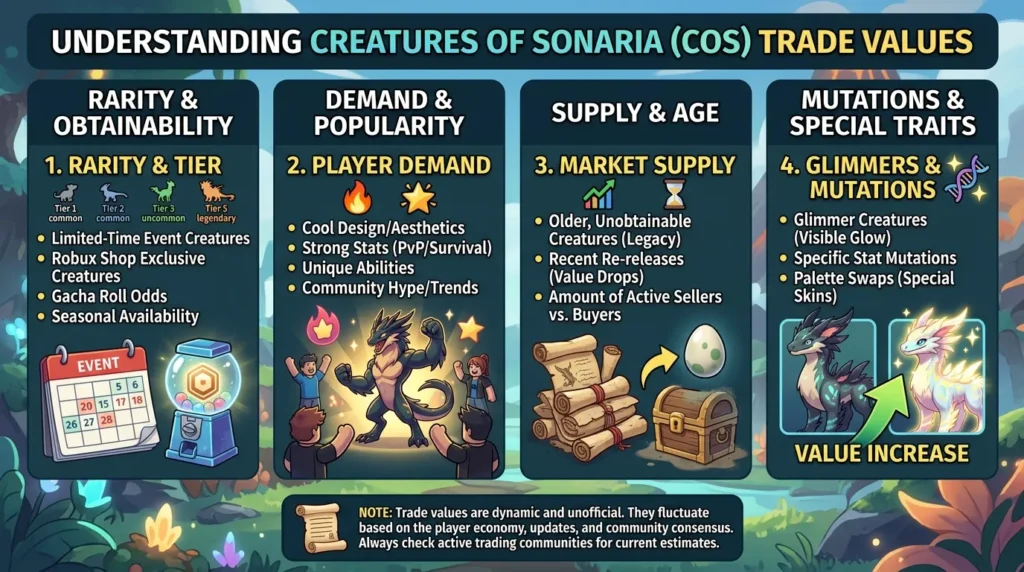
Current values can vary by source and can change over time, so use the figures below as examples of the type of ranges found in a September 2026 market guide rather than permanent prices.
Driffle’s September 2026 list gives examples such as:
| Creature | Listed Value Range | Demand |
|---|---|---|
| Keruku | 450k–500k | Medium |
| Somnia Elus | 300k–500k | High |
| Corvurax | 300k–350k | Medium |
| Mijusuima | 300k–350k | Medium |
| Sigmatox | 200k–300k | High |
| Aolenus | 200k–250k | Medium |
| Owa’Stryrus | 150k–250k | High |
| Etheralotus | 180k–250k | High |
| Verza | 105k–250k | High |
| Aereis | 70k–100k | High |
| Boreal Warden | 30k–45k | Medium |
| Ghartokus | 30k–40k | High |
| Ardor Warden | 15k–20k | High |
These figures show how wide the COS trading market can be. A creature near the top of the table can have a price many times higher than a creature in the middle range.
High-Value Creatures
High-value creatures require more care when trading.
Keruku, for example, is listed by Driffle at around 450k to 500k Mush in its September 2026 guide. Somnia Elus is listed at around 300k to 500k.
A difference of only a few thousand Mush may not seem large on a low-priced creature. On a high-value creature, though, the difference can become much larger.
Before trading one of these creatures, check several current sources and look at recent offers.
Mid-Value Creatures
Mid-value creatures can still involve large amounts of Mush.
Boreal Warden, for example, is listed around 30k to 45k in the September 2026 Driffle guide. Ghartokus is listed around 30k to 40k.
These prices are still high enough that using an old value can cause a noticeable difference.
Low-Value Creatures
Lower-priced creatures may be easier for new traders to handle, but you should still check their demand.
A low-value creature may not be expensive, but it can still be difficult to trade if few players want it.
Don’t assume that a cheap creature is automatically easy to sell.
Why Demand Matters in COS Trading
Demand tells you how much interest players have in an item.
A high-demand creature may attract more offers. A low-demand creature may sit in your inventory for longer.
This matters because two creatures with similar prices can have very different trading activity.
For example:
Creature A: 30k, High demand Creature B: 32k, Low demand
Creature B has the higher listed price. But Creature A may have more active buyers.
That does not mean one is automatically better. It simply gives you another factor to consider.
A good Roblox Creatures of Sonaria value list should show demand whenever possible.
Why Do COS Values Change?
COS values can change for several reasons.
Supply and Availability
If many players can obtain an item, supply can increase.
If an item becomes harder to obtain, available supply may become smaller.
This can affect the price, but demand still matters.
Player Demand
Player interest can move quickly.
A creature can become more popular because players like its appearance, abilities, rarity, or current status in the trading community.
If interest falls, its market can change in the opposite direction.
Events and Limited Releases
Events can affect supply because players may have a temporary way to obtain certain creatures or items.
After an event ends, availability can change.
But being limited does not guarantee a high trading price. Players still need to want the item.
Game Updates
New releases and updates can change what players are looking for.
A new creature can attract attention. Changes to existing creatures can also affect demand.
This is why old value lists should not be treated as current without checking their dates.
Why Different COS Value Lists Show Different Prices
You may search for one creature and find several different prices.
That does not always mean one source is wrong.
Different websites may collect information differently.
Some may use player trades. Others may use community reports, listings, auctions, or other market information.
The update date also matters.
An older Fandom value list from 2021, for example, clearly states that its prices were based on what the creator had seen players trading for and that the prices might not be completely accurate.
That is useful context when comparing older lists with current prices.
How to Check If a COS Trade Value Is Accurate
Before making a large trade, use a simple process.
1. Check the Current Value
Find the exact creature or item in a recently updated list.
2. Check the Date
An old value can be useful for historical information, but it may not represent today’s market.
3. Check Demand
See whether the item has low, medium, or high demand.
4. Compare Recent Offers
Look at several current trade offers.
If a list says 50k but recent offers are consistently around 40k, find out why.
5. Check Special Features
For stored creatures, check mutations and traits.
A normal species value may not apply to a stored creature with special characteristics.
Also see: Linux Gaming Performance vs Windows: Which Is Better for Gaming?
COS Plushie, Token, Palette, and Material Values
A complete Roblox Creatures of Sonaria value list can cover more than species.
Driffle’s current guide also separates tokens and plushies into their own sections.
The same checking process applies to these items.
Check the exact name.
Check availability.
Check demand.
Check the current estimated price.
Then compare recent trades if possible.
Tokens
Token values can change based on availability and demand.
Event-related tokens may need extra attention because their supply can change when an event starts or ends.
Plushies
Plushies can have different prices based on their availability and player interest.
A limited plushie is not automatically expensive. Demand still matters.
Palettes
Players may trade palettes because they want particular colors or because the item is difficult to obtain.
Check whether the palette is still available before relying on an older price.
Materials
Rare and limited materials can also appear in trading markets.
As with every other item, check the exact material rather than assuming similar materials have similar prices.
How Much Is My COS Creature Worth?
Start with the base species.
Then look at the stored creature itself.
Ask:
- Is it normal or mutated?
- Does it have special traits?
- Is the species limited?
- Is the creature currently available?
- What is the current demand?
- What are players offering for it?
This matters because a stored creature may not have the same trading price as a basic species listing.
For example, if a species has an estimated value of 20k, you should not automatically assume every stored version is worth exactly 20k.
Special characteristics can change the offer.
How to Tell If a COS Trade Is Fair
Start by writing down everything on both sides.
For example:
| Your Side | Estimated Value |
|---|---|
| Creature A | 25k |
| Token | 3k |
| Total | 28k |
Then calculate the other side:
| Their Side | Estimated Value |
|---|---|
| Creature B | 22k |
| Plushie | 7k |
| Total | 29k |
The estimated totals are close.
But that is not the end of the check.
Look at demand.
Look at availability.
Check whether one item is much harder to trade.
Also check whether the values are current.
A trade can look equal on paper and still feel different in the market because one item has far more player interest.
Common COS Trading Mistakes
Using an Old Value List
This is one of the easiest mistakes to make.
Always check the update date.
Looking at Price Only
Price and demand should be checked together.
Using One Source
If the trade is expensive, compare several current sources.
Ignoring Mutations
A mutated stored creature may have a different market price from the normal species.
Forgetting Traits
Traits can also affect stored creature trades.
Accepting the First Offer
You can wait and compare other offers, especially for expensive creatures.
Assuming Rare Means Expensive
Rarity is one factor. It does not decide the whole market.
Should You Use a COS Trade Calculator?
A COS trade calculator can help when a trade contains several items.
You enter the items on both sides and compare the estimated totals.
Some community resources combine value lists with WFL calculators, which can make it easier to check a larger trade.
Still, a calculator has limits.
If its values are outdated, the result can also be outdated.
It also cannot predict exactly what another player will accept.
Use the calculator for the math, then check demand and current offers yourself.
Simple Checklist Before Any Major COS Trade
Before confirming a large trade, check:
- Exact creature or item name
- Current estimated value
- Demand
- Availability
- Event or limited status
- Mutation
- Traits
- Recent trade offers
- Other current value sources
- Total value on both sides
If something does not look right, stop and check it again.
You do not need to memorize every price in the game. You just need a reliable way to check the items involved in the trade you are about to make.
FAQs
What Is the Roblox Creatures of Sonaria Value List?
It is a reference showing estimated trade values for COS creatures and other tradeable items.
Are COS Values Fixed?
No. Trading values can change with supply, demand, events, updates, and player activity.
Are Community Value Lists Official?
Community lists are generally references for the player trading market. They should not be treated as guaranteed prices.
Why Do Two Websites Show Different Prices?
They may use different data, update at different times, or reflect different parts of the trading community.
What Does Demand Mean?
Demand shows how much interest players have in an item. High-demand items may have more active buyers than low-demand items.
Can Mutations Change a Creature’s Value?
Yes. A mutation can affect the price of a stored creature, depending on the mutation, species, and current player demand.
Are Limited Creatures Always Expensive?
No. Limited availability can affect supply, but player demand still matters.
How Often Should I Check COS Values?
Check before major trades, especially when dealing with expensive creatures. It is also smart to check after events, new releases, or changes that may affect supply and demand.
Final Thoughts
A Roblox Creatures of Sonaria value list gives you a useful starting point when trading, but it should not be the only thing you check.
Start with the current estimated price.
Then check demand.
Look at recent offers.
Check the exact item and any special details such as mutations or traits.
If different sources show different numbers, compare their update dates and methods before making a decision.
The main thing is to avoid treating a listed price as a guaranteed trade price. COS trading changes over time, and player offers can move away from published estimates.
For small trades, a quick check may be enough.
For expensive creatures, take a few extra minutes and compare several sources. That small amount of research can help you understand the trade before you confirm it.