

Claude Haiku vs Sonnet vs Opus: Which Claude Model Should You Use?

If you’re trying to choose between Claude Haiku vs Sonnet vs Opus, the names can make the decision seem harder than it is. All three belong to Anthropic’s Claude family, but they are designed for different levels of speed, capability, and cost.
In 2026, the comparison is also more important because the Claude lineup has changed significantly. Anthropic currently lists Haiku 4.5, Sonnet 5, and Opus 5, alongside other model versions and specialized offerings.
So which one should you choose?
For quick everyday tasks, Haiku can be the practical choice. For most coding, writing, research, and general work, Sonnet offers a strong balance. For difficult reasoning, demanding coding projects, long-running agents, and professional workloads, Opus is the premium option.
In this guide, we’ll compare Claude Haiku vs Sonnet vs Opus by speed, pricing, coding, writing, reasoning, context, everyday use, and overall value.
Claude Haiku vs Sonnet vs Opus: Quick Answer
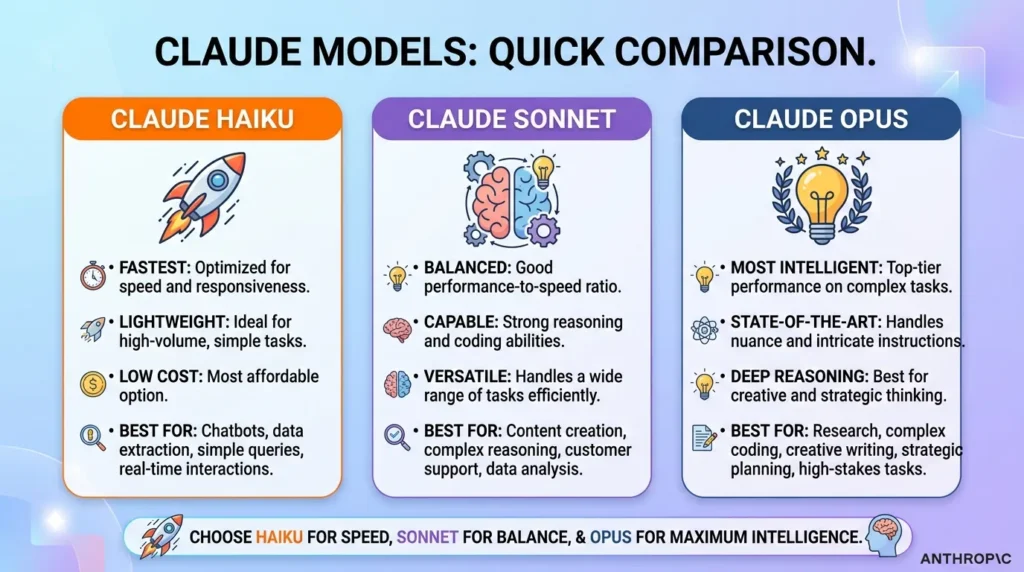
The simplest way to think about the three Claude families is:
| Claude model | Best for | Speed | Capability | Cost |
|---|---|---|---|---|
| Haiku | Fast everyday tasks | Very fast | High | Lowest |
| Sonnet | General work and coding | Fast | Very high | Mid-range |
| Opus | Complex reasoning and demanding work | Slower | Highest | Highest |
These categories are not strict rules. Haiku 4.5, for example, can handle surprisingly demanding work and has been described by Anthropic as a near-frontier model with much greater speed and cost efficiency than larger models.
Sonnet sits between the two in the Claude lineup, while Opus is aimed at tasks where maximum capability is more important than keeping every request inexpensive.
The short recommendation
- Choose Haiku for speed, high-volume requests, simple coding, customer support, and quick answers.
- Choose Sonnet for most users, writers, developers, researchers, and business tasks.
- Choose Opus for complex coding, difficult reasoning, long-running agents, and demanding professional work.
What Are Claude Haiku, Sonnet, and Opus?
Claude is a family of large language models created by Anthropic.
Instead of offering one model for every situation, Anthropic uses different model tiers. Each tier is designed around a different balance between capability, speed, and price.
The three names have traditionally represented different positions in the Claude family:
Haiku
Haiku is designed for speed and lower-cost processing.
It is useful when you need many responses quickly or when a task does not require the highest level of reasoning.
Anthropic describes Claude Haiku 4.5 as a fast model designed for low-latency applications such as chat assistants, customer service, and pair programming.
Sonnet
Sonnet is the middle tier.
It is designed to provide strong intelligence without the higher price of Opus.
The current Claude Sonnet 5 is aimed at coding, agents, research, and other demanding tasks. Anthropic says it can reach Opus-level performance on some tasks while offering a lower cost structure.
Opus
Opus is the premium tier.
It is intended for difficult tasks where reasoning quality, reliability, and sustained work matter more than minimizing cost.
Anthropic describes Claude Opus 5 as its strongest Opus model, with a focus on long-running agents, coding, and professional knowledge work.
Claude Haiku vs Sonnet vs Opus Comparison
Before looking at each model separately, here’s a simple comparison.
| Category | Haiku | Sonnet | Opus |
|---|---|---|---|
| Speed | Excellent | Very good | Good |
| Cost | Lowest | Medium | Highest |
| Everyday questions | Excellent | Excellent | Excellent |
| Writing | Very good | Excellent | Excellent |
| Coding | Very good | Excellent | Excellent |
| Complex reasoning | Good | Excellent | Outstanding |
| Long-running tasks | Good | Excellent | Excellent |
| High-volume applications | Excellent | Very good | Expensive |
| Customer support | Excellent | Very good | Usually unnecessary |
| Advanced research | Good | Excellent | Excellent |
| Difficult software projects | Good | Excellent | Excellent |
| Best for budget-conscious users | Yes | Yes | No |
| Best for maximum capability | No | Sometimes | Yes |
Keep in mind that model behavior and pricing can change as Anthropic releases new versions. Always check the current model documentation before selecting a model for a production application.
Claude Haiku: Best for Speed and Lower Cost
If your first priority is fast responses, Haiku is the model family to consider.
The current Haiku model, Claude Haiku 4.5, was introduced as a fast model that can handle tasks much closer to larger Claude models than earlier Haiku versions could. Anthropic lists its API pricing at $1 per million input tokens and $5 per million output tokens.
That makes Haiku attractive for high-volume API requests and real-time applications where low latency and lower cost are priorities.
Haiku is a good fit for:
- Quick questions
- Text classification
- Customer support
- Summaries
- Simple content generation
- Chat assistants
- Basic coding
- Rapid prototypes
- High-volume API requests
- Real-time applications
Imagine a customer support system receiving thousands of short questions.
Using the most expensive Claude model for every simple request could raise costs without providing much additional benefit.
Haiku can handle many of these requests quickly.
Claude Haiku for Coding
Haiku is not limited to basic text tasks.
Anthropic says Haiku 4.5 offers strong coding ability and is useful for pair programming and agent-based development.
It can be a good choice for:
- Small scripts
- Simple bug fixes
- Code explanations
- Boilerplate code
- Unit tests
- Small frontend changes
- Quick code reviews
However, difficult software projects can benefit from Sonnet or Opus.
If your task involves understanding a large unfamiliar codebase, tracing a complicated bug, or making changes across many files, a more capable model may save time.
Claude Haiku for Writing
Haiku can handle many everyday writing tasks.
You can ask it to:
- Rewrite an email
- Create social media captions
- Summarize an article
- Generate product descriptions
- Improve grammar
- Create short blog sections
- Turn notes into a draft
- Simplify complicated text
For short content, the difference between Haiku and more expensive models may not matter much.
If you are writing a simple email, you probably don’t need the most expensive Claude model.
Claude Sonnet: The Balanced Choice
If you don’t know which Claude model to pick, Sonnet is usually the safest starting point.
The current Claude Sonnet 5 is designed for strong performance across coding, agent tasks, research, and general professional work. Anthropic says Sonnet 5 is available across Claude plans and API access, with permanent pricing of $2 per million input tokens and $10 per million output tokens.
That puts Sonnet between Haiku and Opus in price.
But its value comes from more than price.
Sonnet can handle both everyday questions and complicated projects without requiring the highest-cost model for every request.
Sonnet is a strong choice for:
- Blog writing
- Research
- Coding
- Debugging
- Document analysis
- Business writing
- Data interpretation
- Planning
- Long conversations
- Software development
- Agent workflows
- Technical explanations
For many users, Sonnet is the best overall Claude model.
Claude Sonnet for Coding
Coding is one of Sonnet’s strongest areas.
Anthropic’s current Sonnet 5 announcement highlights improvements in coding and multi-step software engineering work. The company reports that Sonnet 5 can handle sustained coding, debugging, tool use, and complex technical contexts.
This makes Sonnet a strong default for coding, agent tasks, research, and general professional work.
For example, you could ask Sonnet to:
- Read a project structure.
- Identify the cause of a bug.
- Explain the problem.
- Suggest a fix.
- Modify the relevant files.
- Write tests.
- Review the changes.
The more complex the task becomes, the more useful a stronger model can be.
Claude Sonnet for Writing
For writers, Sonnet is often an excellent middle ground.
It can handle:
- Long-form articles
- SEO content
- Product comparisons
- Research summaries
- Email campaigns
- Technical documentation
- Reports
- Scripts
- Editing
- Rewriting
- Brainstorming
It is also useful when you want a consistent tone across a large document.
For example, if you’re creating a 3,000-word technology article, Sonnet can help maintain structure and context across the entire piece.
Claude Opus: The Premium Choice
Claude Opus is designed for situations where maximum model capability is more important than minimizing cost.
The current Opus family includes Claude Opus 5, which Anthropic describes as its strongest Opus model for long-running agents, coding, and professional knowledge work.
Opus is most useful when the problem itself is difficult.
You may not notice a major difference between Sonnet and Opus when asking:
“Write a short birthday message.”
But the difference can become more meaningful when you ask:
Anthropic’s current Opus materials highlight long-running agent workflows, complex coding, and professional knowledge work as key use cases.
That type of task gives a stronger reasoning model more room to show its value.
Claude Opus for Coding
Opus is particularly useful for demanding development work.
Potential use cases include:
- Large codebases
- Complex debugging
- Architecture planning
- Multi-step software development
- Advanced code review
- Difficult refactoring
- Long-running coding agents
- Technical research
Anthropic’s current Opus materials highlight coding and long-running agent work as key use cases.
That does not mean every developer should use Opus.
If Sonnet completes your coding task successfully, paying more for Opus may not make sense.
The better approach is to match the model to the difficulty of the job.
Claude Opus for Writing and Research
Opus can also be useful for complicated writing and research tasks.
For example:
- Analyzing a long technical report
- Comparing competing business strategies
- Creating a detailed research plan
- Reviewing complex documentation
- Connecting information across multiple documents
- Producing detailed professional reports
If the task requires several reasoning steps, Opus can be worth considering.
For a short article or simple rewrite, however, Sonnet or Haiku may be enough.
Claude Haiku vs Sonnet: Which Is Better?
Between Haiku and Sonnet, Sonnet is more capable overall, while Haiku is faster and less expensive.
The better option depends on your workload.
Choose Haiku when:
- Speed matters most.
- Requests are simple.
- You have many API calls.
- Your budget is limited.
- You need real-time responses.
- You are processing short pieces of text.
Choose Sonnet when:
- You need stronger reasoning.
- You write long articles.
- You develop software.
- You analyze documents.
- You want a general-purpose model.
- You need better results on complicated instructions.
A useful rule is:
If Haiku gets the job done, use Haiku. If the task starts becoming difficult, move to Sonnet.
For a detailed, task-by-task breakdown of when Haiku is enough and when Sonnet is worth the extra cost, including classification, extraction, formatting, multi-step reasoning, code generation, and long-context work, see this Sonnet vs Haiku comparison
Claude Sonnet vs Opus: Which Is Better?
This comparison is closer.
Both can handle demanding work, but Opus is intended for the highest level of capability.
Sonnet is better when:
- You want a strong balance of cost and quality.
- You use Claude frequently.
- You need coding help.
- You write or research regularly.
- You build agents.
- You want strong performance without premium pricing.
Opus is better when:
- The task is extremely difficult.
- Mistakes are expensive.
- You need deeper reasoning.
- You work on complex software.
- You need long-running agents.
- You want the highest capability available in the Opus family.
For many users, Sonnet will be enough.
Opus becomes more attractive when the cost of a weaker answer is greater than the extra model cost.
Claude Haiku vs Opus: Which Is Better?
These two models sit at opposite ends of the traditional Claude lineup.
Haiku emphasizes speed and lower cost.
Opus emphasizes maximum capability.
Haiku makes more sense for:
- Simple requests
- Short summaries
- Chat applications
- Classification
- High-volume workloads
- Quick responses
Opus makes more sense for:
- Difficult reasoning
- Advanced coding
- Complex research
- Long-running tasks
- Professional analysis
- Large multi-step projects
For most everyday users, there is no reason to use Opus for every request.
Which Claude Model Is Fastest?
Haiku is the speed-focused choice.
Anthropic introduced Haiku 4.5 specifically around fast responses and lower latency. The company says it can run substantially faster than Sonnet 4.5 while maintaining strong capability.
Low-latency streaming is crucial during real-time applications, interactive assistants, and high-volume API workloads.
This is especially important for:
- Customer service
- Voice applications
- Interactive assistants
- Real-time coding help
- Large API workloads
- Automated classification
If response time is your top priority, start with Haiku.
Which Claude Model Is Cheapest?
Among the three current tiers discussed here, Haiku is the least expensive.
Anthropic lists Haiku 4.5 at:
- $1 per million input tokens
- $5 per million output tokens
Sonnet 5 is listed at:
- $2 per million input tokens
- $10 per million output tokens
Opus 5 starts at:
- $5 per million input tokens
- $25 per million output tokens
API pricing comparison
| Model | Input / 1M tokens | Output / 1M tokens |
|---|---|---|
| Haiku 4.5 | $1 | $5 |
| Sonnet 5 | $2 | $10 |
| Opus 5 | $5 | $25 |
These are API token prices and should not be confused with Claude’s consumer subscription plans. Anthropic’s API pricing page provides current pricing details and should be checked before publishing or budgeting for a production application.
Which Claude Model Is Best for Coding?
If you’re choosing only one model for coding, Sonnet is a strong choice for most developers.
It offers a useful combination of capability and cost.
Haiku can be excellent for smaller coding tasks.
Opus is more suitable for difficult engineering problems where deeper reasoning and sustained work are important.
Coding recommendation
Simple code: Haiku
Regular development: Sonnet
Complex engineering: Opus
This approach can also reduce costs.
There’s no reason to send every tiny coding question to the most expensive model.
Which Claude Model Is Best for Writing?
For most writers, Sonnet is the best overall choice.
It can handle:
- Blog posts
- Product reviews
- SEO articles
- Reports
- Scripts
- Emails
- Editing
- Rewriting
- Research-based content
Haiku is useful for short-form writing.
Opus can help with complicated research, detailed analysis, and long professional documents.
Writing recommendation
Short content: Haiku
Most articles: Sonnet
Complex research and professional writing: Opus
Which Claude Model Is Best for Research?
The answer depends on how difficult the research task is.
For simple summaries, Haiku may be enough.
For most research and document analysis, Sonnet is a strong choice.
For complicated research involving many pieces of information and several reasoning steps, Opus may provide better results.
Keep in mind that model knowledge and access to external tools are separate issues.
A more capable model does not automatically mean it has access to every current piece of information.
Which Claude Model Is Best for Everyday Users?
For everyday users, Sonnet is the easiest recommendation.
You can use it for:
- Questions
- Writing
- Coding
- Research
- Planning
- Summaries
- Brainstorming
- Learning
- Document work
Haiku is a good choice when speed matters.
Opus is worth considering when you regularly work on difficult tasks.
If you’re not sure, start with Sonnet and move up or down based on your actual needs.
Claude Haiku vs Sonnet vs Opus for Businesses
Businesses often have different requirements from individual users.
A company may need to process thousands or millions of requests.
In that situation, model cost becomes very important.
For example, a customer-support application may receive thousands of short questions every day.
Using Haiku for straightforward requests can keep costs lower.
More difficult requests can then be routed to Sonnet or Opus.
A practical model-routing strategy
Haiku: Simple questions and classification
↓
Sonnet: Medium-difficulty questions
↓
Opus: Complex cases requiring deeper reasoning
For a broader view of how the Claude family evolved, including the newer Fable/Mythos tiers and how Haiku, Sonnet, and Opus differ in reasoning controls, context windows, and deployment options, see this Claude models explained guide
This type of model routing can give businesses more control over cost and response quality.
For a production-focused breakdown of when to use each model, including cost-optimization patterns such as “triage → build → review” and “planner/executor split,” see this Opus vs Sonnet vs Haiku guide.
Claude Haiku vs Sonnet vs Opus for Developers
Developers can also combine the three models rather than selecting only one.
For example:
Haiku
Use it for:
- Code formatting
- Small edits
- Simple tests
- Classification
- Quick explanations
Sonnet
Developers frequently leverage Sonnet for feature development, debugging, code review, refactoring, and general programming tasks.
- Feature development
- Debugging
- Code review
- Refactoring
- General programming
Opus
Use it for:
- Architecture
- Difficult debugging
- Large migrations
- Complex agent tasks
- High-value engineering problems
This approach lets developers choose the model based on the task rather than treating one model as the answer to everything.
Does a More Expensive Claude Model Always Give Better Results?
No.
This is an important point.
Model capability is only one part of the final result.
The quality of your prompt, available context, tools, source material, and task structure also matter.
A simple request may produce an excellent result with Haiku.
A poorly written prompt can produce a disappointing result even with Opus.
Think about it this way:
A stronger engine doesn’t automatically make every trip better.
If you’re driving to a nearby store, you don’t need a race car.
The same idea applies to Claude.
Claude Models and Context
Context refers to the information a model can consider while working on a task.
This matters when you’re dealing with:
- Long documents
- Large codebases
- Research projects
- Detailed instructions
- Multiple files
- Long conversations
Anthropic’s model documentation provides current context and capability information for its models. Because these limits and features can change with new releases, check the current official model documentation when building an application.
A large context window is useful, but it does not remove the need for good organization.
Giving a model thousands of pages of irrelevant information can make a task harder rather than easier.
Claude Haiku vs Sonnet vs Opus: Pros and Cons
| Model | Pros | Cons |
|---|---|---|
| Haiku | Very fast, low cost, strong for many simple tasks | Not the first choice for the hardest reasoning tasks |
| Sonnet | Strong quality, good speed, broad use cases, moderate cost | More expensive than Haiku |
| Opus | Highest capability tier, strong for complex work | Costs more and may be unnecessary for simple tasks |
Which Claude Model Should You Choose?
Here’s the simplest decision guide.
Choose Claude Haiku if:
You care most about speed and cost.
It’s a good fit for high-volume applications, short requests, simple coding, summaries, and customer support.
Choose Claude Sonnet if:
You want the best general-purpose balance.
It’s the model I’d recommend to most writers, developers, students, researchers, and everyday Claude users.
Choose Claude Opus if:
You care most about maximum capability for difficult work.
It’s the model to consider for complex coding, advanced reasoning, professional analysis, and long-running agent tasks.
Claude Haiku vs Sonnet vs Opus: Final Comparison
| Need | Recommended model |
|---|---|
| Fastest responses | Haiku |
| Lowest API cost | Haiku |
| Everyday questions | Sonnet |
| Blog writing | Sonnet |
| SEO content | Sonnet |
| General coding | Sonnet |
| Advanced coding | Opus |
| Difficult reasoning | Opus |
| Customer support | Haiku |
| High-volume API use | Haiku |
| Business research | Sonnet |
| Complex professional work | Opus |
| Best overall balance | Sonnet |
| Highest capability | Opus |
Frequently Asked Questions
Is Claude Haiku better than Sonnet?
Haiku is better when speed and lower cost are your main priorities. Sonnet is better for more demanding tasks such as coding, research, long-form writing, and complex instructions.
Is Claude Sonnet better than Opus?
Not for every task. Sonnet offers a strong balance of quality and cost, while Opus is intended for harder tasks where maximum capability matters more.
Which Claude model is best?
For most users, Sonnet is the easiest starting point. Haiku is better for speed and lower cost, while Opus is better for difficult professional workloads.
Which Claude model is best for coding?
Sonnet is a strong general choice for coding. Haiku works well for smaller coding tasks, while Opus is more suitable for complex software engineering.
Which Claude model is cheapest?
Haiku is the least expensive of the three model tiers discussed here. Anthropic lists Haiku 4.5 at $1 per million input tokens and $5 per million output tokens.
Which Claude model is fastest?
Haiku is the speed-focused Claude model. Anthropic specifically positions Haiku 4.5 for low-latency applications and fast responses.
Is Claude Opus worth the extra cost?
It can be if you’re working on difficult coding, research, reasoning, or long-running tasks where a stronger model can save time or improve the result. For simple tasks, Sonnet or Haiku may be enough.
Can I use different Claude models in the same application?
Yes. Developers can design applications that route different tasks to different models. For example, simple requests can go to Haiku while more complex requests go to Sonnet or Opus.
Which Claude model should I use for SEO articles?
Sonnet is a strong choice for most SEO articles because it offers good writing quality and can handle detailed instructions, research, structure, and long-form content.
Which Claude model should I use for simple questions?
Haiku is a good choice when you want quick answers at a lower API cost. Sonnet is also suitable if you prefer stronger reasoning.
Final Verdict: Claude Haiku vs Sonnet vs Opus
So, which is better: Claude Haiku, Sonnet, or Opus?
There isn’t one winner for every situation.
Claude Haiku is the speed and cost choice. It makes sense when you’re handling many simple requests or need quick responses. Haiku 4.5 is also much more capable than the older idea of a small, basic Claude model might suggest.
Claude Sonnet is the best overall choice for most people. It offers strong writing, coding, research, reasoning, and general-purpose performance without the higher API cost of Opus. The current Sonnet 5 also brings stronger coding and agent capabilities than earlier Sonnet generations.
Claude Opus is for the hardest jobs. If you’re working on complex software, difficult reasoning problems, long-running agents, or high-value professional work, the extra capability can justify the higher price. Anthropic currently positions Opus 5 as its strongest Opus model.
Our simple recommendation:
Haiku = Fast and affordable
Sonnet = Best overall balance
Opus = Maximum capability
If you’re still unsure, start with Sonnet. Test it on your real work, then move to Haiku when speed and cost matter more or to Opus when the task needs greater reasoning depth.
The best Claude model isn’t always the most expensive one.
It’s the model that gives you the quality you need at a cost and speed that make sense for your particular task.