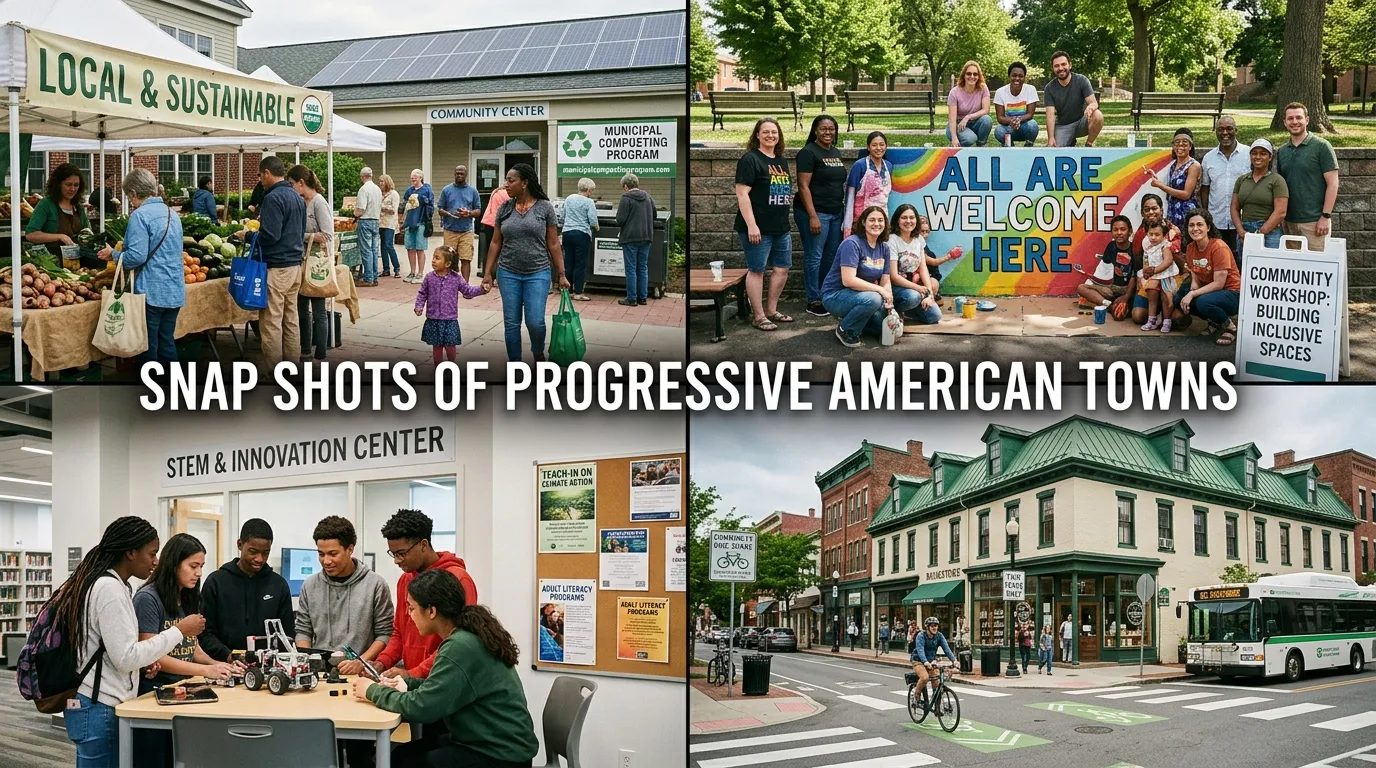
15 Most Progressive Towns in America: Small Communities With Big Ideas

What makes a town feel progressive? It is often more than politics. People may look for walkable streets, local businesses, green spaces, public services, affordable housing, and a community that welcomes different backgrounds. That is why the most progressive towns in America can be interesting for people who are thinking about where to live, work, or spend more time.
What stands out is how these ideas show up in ordinary places. A town might make it easier to walk to shops, support local businesses, protect green spaces, or expand access to public services. I think those everyday changes tell us more about a community than a label ever could.
This article looks at the most progressive towns in America and the features that set them apart. You’ll learn about their local policies, environmental efforts, transportation systems, housing approaches, and community programs. You’ll also see how each town has its own priorities.
There is no single formula for making a town progressive. Some focus on sustainability, while others put greater attention on housing, inclusion, or public spaces. Keep reading to see which towns are leading these efforts and what makes each one different.
Most Progressive Towns in America at a Glance
| Town | State | Known for | Best for |
|---|---|---|---|
| Burlington | Vermont | Progressive politics, lake, arts | Community and outdoor lifestyle |
| Ithaca | New York | Education, nature, activism | Students and academics |
| Northampton | Massachusetts | Arts, LGBTQ+ culture, colleges | Creative lifestyles |
| Boulder | Colorado | Environment, mountains, university | Outdoor enthusiasts |
| Asheville | North Carolina | Arts, mountains, local businesses | Artists and food lovers |
| Carrboro | North Carolina | College culture, local businesses | Young professionals |
| Taos | New Mexico | Art, culture, mountains | Artists and nature lovers |
| Oberlin | Ohio | Education, music, arts | Students and academics |
| Yellow Springs | Ohio | Alternative culture | Small-town living |
| Saugatuck | Michigan | Art, Lake Michigan | Lakeside lifestyle |
| Eureka Springs | Arkansas | Arts, history, mountains | Alternative Southern lifestyle |
| Amherst | Massachusetts | Higher education | Academic community |
| Montpelier | Vermont | Politics, community | Quiet Vermont lifestyle |
| Telluride | Colorado | Skiing, mountains, festivals | Outdoor enthusiasts |
| Santa Fe | New Mexico | Art, culture, history | Creative lifestyles |
What Are the Most Progressive Towns in America?
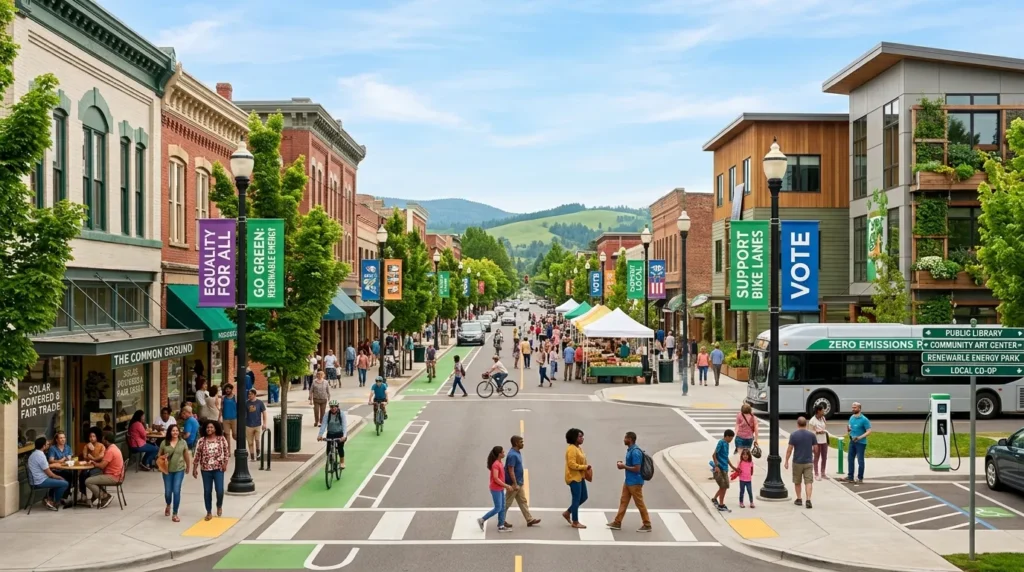
The phrase most progressive towns in America is commonly used to describe smaller communities with progressive political cultures or policies, active civic life, environmental programs, inclusive community spaces, and strong local culture.
But there is no single definition.
For one person, a progressive town may be a place with good public transportation and bike paths. Another person may care more about LGBTQ-friendly businesses, environmental policies, public schools, or local arts.
Some communities have several of these features. Others have only a few.
This matters because a town can have a progressive reputation while still having expensive housing or limited public transportation. Another town may have affordable homes but fewer cultural activities.
Looking at the details gives you a much clearer picture.
What Makes a Town Progressive?
Several factors commonly come up when people discuss progressive small towns in America.
Walkability and Transportation
A walkable community gives residents ways to reach stores, restaurants, schools, parks, and other places without depending on a car for every trip.
Bike lanes and shared-use paths can also make a difference. Public transportation is another factor, especially for people who cannot or do not want to drive.
Northampton, Massachusetts, for example, has a network of multi-use trails, bicycle lanes, and sidewalks. The city’s planning documents describe about 14 miles of multi-use trails and around 8.5 miles of bicycle lanes. Its downtown is also described as highly walkable.
Housing Choices
Housing is another major part of the discussion.
People may want apartments, smaller homes, family houses, or homes close to downtown. A community can have progressive policies and still have housing costs that make it difficult for some people to move there.
That is why affordable progressive towns can be harder to find than towns that simply have a progressive reputation.
Diversity and Inclusion
Some people also look for diverse communities, LGBTQ-friendly businesses, inclusive organizations, and public spaces where different groups can participate comfortably.
It is important to separate political culture from demographic diversity, though. A town can be politically progressive without having a highly diverse population.
Environmental Policies and Outdoor Access
Parks, trails, conservation areas, recycling programs, clean transportation, and open-space planning can also be part of a town’s identity.
Outdoor access matters for another reason. People often want the small-town feel without giving up easy access to hiking, cycling, parks, rivers, or other natural areas.
Towns Often Discussed as Progressive Communities
There is no universal ranking here. The following places are examples of communities that are often discussed because of their combination of local culture, transportation, outdoor access, education, or community programs.
Northampton, Massachusetts
Northampton is one of the smaller New England communities that often comes up when people search for progressive towns in the US.
Its downtown has a strong local-business presence, while city planning has focused on different forms of transportation. Northampton’s Main Street redesign was started with the goal of serving pedestrians, cyclists, transit riders, mobility-device users, drivers, and other road users.
The city also has several connected trail systems. The Northampton Bikeway links downtown with nearby areas, while other rail trails connect the city to neighboring communities.
That combination gives the city a practical advantage for people who enjoy walking and cycling.
Northampton also has a strong connection to education and the arts. Its location in western Massachusetts places it near several colleges, cultural institutions, restaurants, and independent businesses.
The downside is that a community with a strong reputation can also face housing pressure. Anyone considering Northampton should look at current rents, home prices, employment, and transportation costs before moving.
Burlington, Vermont
Burlington is another name that frequently appears in conversations about progressive small cities.
It has a compact setting, access to Lake Champlain, outdoor recreation, local businesses, and a strong community culture.
Its location also gives residents access to parks, trails, waterfront activities, and nearby natural areas.
For someone searching for a progressive community with outdoor access, Burlington can be an interesting place to research.
However, lifestyle is only one part of the decision.
Housing prices, job opportunities, winter weather, transportation, taxes, and daily expenses all matter. A town may have the culture you want but still fail to fit your budget.
That is a common issue with many popular progressive communities.
Davis, California
Davis is especially well known for cycling and transportation planning.
The city currently reports 63 miles of pathways, 102 miles of bike lanes, 25 grade-separated crossings, and thousands of bike racks. Its transportation program also includes active transportation and Safe Routes to School programs.
Davis also has public transportation options. Unitrans provides scheduled bus service within Davis, while other services connect the city with nearby communities and the Sacramento region.
This makes Davis an important example for people searching for walkable progressive towns or progressive college towns.
The presence of UC Davis also contributes to the community’s educational and cultural life.
At the same time, California housing costs can be a major consideration. Someone researching Davis should compare housing costs with local wages and commuting needs instead of looking only at the city’s amenities.
Lawrence, Kansas
Lawrence offers a different version of the progressive college-town experience.
The University of Kansas has a major influence on the city. The community also has restaurants, local businesses, cultural events, and an active downtown.
Transportation is another area worth examining. Lawrence works with the University of Kansas to provide Lawrence Transit, while the city has a pedestrian plan focused on improving walkability. Its transportation planning also includes bicycle infrastructure and a Complete Streets policy.
These features make Lawrence relevant to people looking for progressive college towns with walking, cycling, and public transportation options.
The university environment can also mean more activity than you might expect from a smaller city. Students, faculty, local residents, businesses, and visitors all contribute to the atmosphere.
As with any town, though, neighborhood matters. Someone looking for a quieter residential area may have a different experience from someone living close to downtown or campus.
Yellow Springs, Ohio
Yellow Springs is much smaller than Davis or Lawrence, but it has several characteristics associated with liberal small towns and progressive communities.
The village describes itself as having a strong cultural history, creative community, locally focused downtown, independent shops, restaurants, and outdoor attractions. It is also home to Antioch College and WYSO public radio.
Outdoor access is one of its noticeable features.
Yellow Springs maintains 14 parks and has access to the Little Miami Scenic Trail. The trail connects the village with areas to the north and south and is used by walkers, cyclists, and skaters.
The village also has community recreation programs, youth facilities, sports fields, and other public spaces.
For someone who wants a small community with arts, independent businesses, and nearby nature, Yellow Springs is worth researching.
Its small size is also something to consider. A town with fewer residents will naturally have fewer services and businesses than a larger city.
Other Progressive Communities to Research
The towns above are not the only communities that appear in discussions about progressive living.
Other names that may come up include:
- Ithaca, New York
- Oberlin, Ohio
- Amherst, Massachusetts
- Montpelier, Vermont
- Eau Claire, Wisconsin
These communities have different populations, housing markets, economies, and local cultures.
That is why a simple list of the most progressive towns in America cannot tell you whether a particular place is right for you.
Instead, use the list as a starting point.
Also see: Is Rochester New York Safe? A Friendly Guide to Crime, Neighborhoods, and Safety
Why Walkability Matters
Walkability is often one of the biggest reasons people search for progressive small towns.
Being able to walk to a restaurant is convenient. Being able to walk to a grocery store, pharmacy, library, school, park, or workplace can have a much bigger effect on daily life.
Walkability can also make a downtown feel more active.
But there is an important detail to remember: a walkable downtown does not mean the entire town is walkable.
Before choosing a community, look at the specific neighborhood where you might live.
Check the distance to:
- Grocery stores
- Schools
- Parks
- Restaurants
- Public transit
- Healthcare
- Work
- Bike paths
Google Maps can help with basic distances, but visiting the area can tell you much more.
Are Progressive Towns Affordable?
Affordability is one of the biggest challenges.
Many people searching for affordable walkable towns want the same combination: reasonable housing, local businesses, good schools, outdoor space, and easy transportation.
Those features can increase demand.
Do not compare towns based only on home prices. Look at the complete monthly cost.
Consider:
- Rent or mortgage
- Property taxes
- Insurance
- Utilities
- Transportation
- Groceries
- Healthcare
- Childcare
- Commuting
For example, a cheaper house farther from work may cost more over time because of fuel, vehicle maintenance, parking, and commuting.
The same applies to apartments. A slightly more expensive apartment near work and public transportation may have different overall costs than a cheaper apartment that requires daily driving.
Progressive Does Not Always Mean Diverse
This is another point worth keeping clear.
Political culture and demographic diversity are not the same thing.
A town may have progressive local policies or voting patterns but still have a relatively small or less diverse population. Another community may be highly diverse but have a mix of political views.
If diversity matters to you, research population data, schools, local organizations, cultural events, and community groups separately.
The same applies to LGBTQ-friendly communities. Look at local organizations, businesses, public events, and community resources rather than assuming that a political label tells you everything.
How to Choose the Right Town
Decide What Matters Most
Start with five or six things you need from a community.
For example:
- Affordable housing
- Walkable neighborhood
- Good schools
- Outdoor access
- Public transportation
- Local businesses
This makes your search much easier.
Research the Exact Neighborhood
Do not stop at town-level information.
Check the neighborhood, street, commute, nearby stores, schools, parks, and transit options.
Two parts of the same town can offer very different lifestyles.
Check Housing Before Getting Attached
Housing should be one of the first things you research.
Look at current rental listings and home prices. Check how long properties stay on the market. Look at taxes and insurance if you plan to buy.
A town may seem perfect until you see what housing costs.
Visit During Normal Days
A weekend festival can make almost any town look exciting.
Try to visit during an ordinary weekday too.
Walk around. Visit a grocery store. Use public transportation if available. Check the commute. Spend time downtown and in residential areas.
That gives you a more realistic picture.
Common Misconceptions About Progressive Towns
Progressive Does Not Mean Affordable
A town can have progressive policies and expensive housing.
These are separate issues.
Progressive Does Not Mean Perfect
Every community has problems. Traffic, housing shortages, taxes, school issues, development debates, and infrastructure needs can exist in any town.
Small Does Not Mean Quiet
College towns can be busy. Arts communities can have crowded event calendars. Tourist towns can become especially active during certain seasons.
Walkable Downtown Does Not Mean Walkable Everywhere
Always check the specific area where you plan to live.
Frequently Asked Questions
What are the most progressive towns in America?
Frequently mentioned examples include Burlington, Ithaca, Northampton, Boulder, Asheville, Carrboro, Taos, Oberlin, Yellow Springs, Saugatuck, Montpelier, and Telluride. There is no single official ranking, so different lists produce different results.
What is the most progressive small town in the United States?
Burlington, Vermont, is one of the most commonly cited examples. Its progressive political history and community culture have made it a prominent example of progressive politics in a smaller American community.
Are progressive towns mostly in blue states?
Many well-known examples are in states such as Vermont, Massachusetts, New York, Colorado, and California. However, progressive communities also exist in states that are more conservative overall, including North Carolina, Arkansas, Ohio, and Michigan.
What are the best progressive towns for families?
Northampton, Burlington, Ithaca, Boulder, and some smaller communities around college towns can be worth considering. Families should compare schools, housing, healthcare, transportation, and employment rather than relying on political reputation alone.
What are the most progressive mountain towns?
Boulder, Telluride, Asheville, and Taos are among the better-known examples. Their political culture differs, but all combine mountain or outdoor access with progressive or alternative cultural traditions.
Are progressive small towns expensive?
Some are. Boulder, Telluride, Northampton, Burlington, and other popular communities can have high housing costs, especially in places with limited housing supply, strong tourism, university demand, or high-paying local job markets.
Are there progressive towns in conservative states?
Yes. Asheville and Carrboro in North Carolina and Eureka Springs in Arkansas are examples frequently mentioned in discussions of progressive small communities outside traditionally blue states.
Final Thoughts
The most progressive towns in America aren’t all alike.
Some are mountain communities. Others sit beside lakes. Some are built around universities, while others developed strong arts scenes or alternative cultures.
Burlington offers progressive politics and lakefront living. Ithaca combines education with natural beauty. Northampton brings together arts and community life. Boulder offers mountains and environmental culture. Asheville adds a Southern setting with a strong arts scene.
The important thing is to look beyond the label.
A town’s political reputation can tell you something about its culture, but it doesn’t tell you whether you’ll enjoy living there. Housing costs, jobs, schools, healthcare, transportation, climate, and access to the things you care about should all be part of your decision.
If you’re searching for a place where community involvement, environmental awareness, cultural diversity, and progressive social values are an important part of local life, the towns on this list are excellent places to start your research.