Mercaptan Odor Removal: How to Get Rid of Strong Sulfur Smells Safely

If you’ve ever noticed a strong rotten cabbage, garlic, or sulfur-like smell, you may be dealing with a mercaptan odor. Mercaptans, also called thiols, are sulfur-containing compounds known for their extremely strong odors. Some are used as odorants in natural gas and liquefied petroleum gas (LPG) so that people can detect a potential leak.
That creates an important distinction when dealing with mercaptan odor removal: if the smell could be coming from a gas leak, removing the odor should not be your first priority. The source needs to be identified and made safe first.
Once the source has been controlled, lingering mercaptan odor can sometimes remain in air, fabrics, porous materials, equipment, wastewater areas, or other surfaces. The right removal method depends on the specific mercaptan, concentration, material affected, and source.
This guide explains why mercaptans smell so strongly, how odor removal works, what methods can help, and when you should bring in a qualified professional.
What Is Mercaptan?
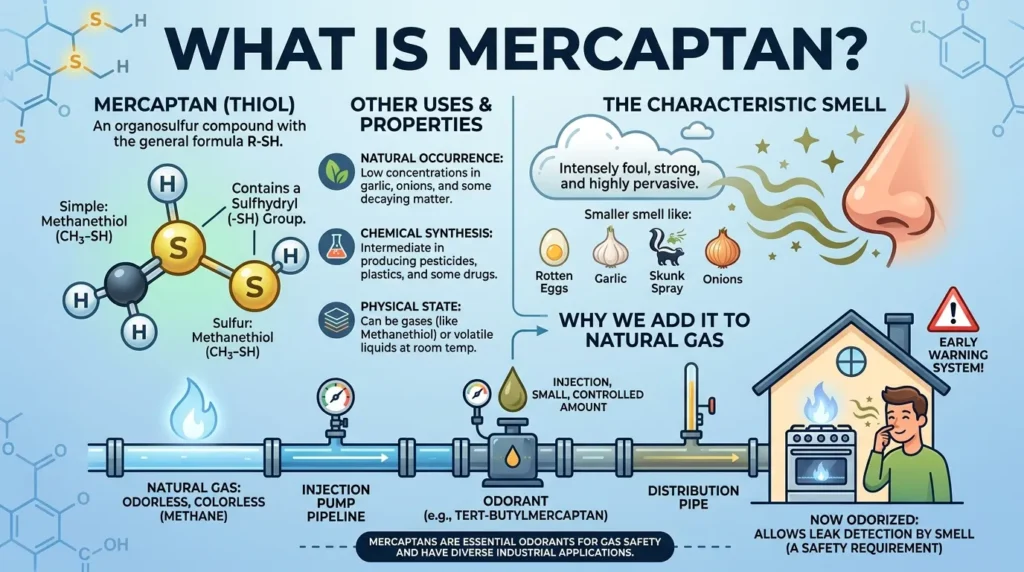
A mercaptan is a sulfur-containing organic compound, also known as a thiol. Common examples include methyl mercaptan and ethyl mercaptan.
These compounds have very low odor thresholds. In other words, people can detect their smell at extremely low concentrations. EPA data, for example, lists an odor-awareness level of about 1.9 parts per billion for methyl mercaptan and a distinct odor-awareness level of 0.00014 ppm for ethyl mercaptan.
This explains why a space can smell strongly of sulfur even when the amount of chemical present is relatively small.
Mercaptans can occur in industrial processes, wastewater environments and other settings, but they are also deliberately added to fuel gases as warning odorants. OSHA regulations specifically recognize ethyl mercaptan and other odorants for LPG.
Why Does Mercaptan Smell So Strong?
Mercaptans are notorious for their powerful odors.
Depending on the compound and concentration, people may describe the smell as:
- Rotten cabbage
- Rotten vegetables
- Garlic
- Sulfur
- Skunk-like
- Decaying organic matter
The human nose is remarkably sensitive to many sulfur-containing compounds. This is useful when mercaptans are used as gas odorants because a person may notice the smell before a dangerous gas concentration is reached.
However, the presence of an odor does not tell you exactly how much mercaptan is present.
That’s why you shouldn’t try to determine whether a gas leak is safe simply by judging how strong the smell is.
First Step in Mercaptan Odor Removal: Find the Source
Before trying air fresheners, cleaning products, activated carbon or other treatments, identify where the mercaptan is coming from.
Potential sources can include:
- Natural gas or LPG
- Industrial chemicals
- Wastewater
- Sewage treatment processes
- Landfills
- Chemical manufacturing
- Petroleum processing
- Contaminated equipment
- Spilled chemicals
- Organic material containing sulfur compounds
Research documented by the U.S. Environmental Protection Agency has identified methyl mercaptan and other sulfur compounds as important odor contributors in wastewater environments.
If the smell appeared suddenly and you suspect a fuel-gas leak, treat it as a potential gas emergency rather than an ordinary household odor problem.
What to Do if You Smell Mercaptan and Suspect a Gas Leak
If you smell an odor that may be from natural gas or LPG:
- Do not try to locate the leak yourself.
- Avoid flames, smoking and anything that could create a spark.
- Don’t operate electrical switches if you are in the suspected leak area.
- Leave the area if necessary.
- Contact your gas supplier or emergency service from a safe location.
- Have the source professionally inspected before returning to normal use.
Mercaptan is added to otherwise odorless fuel gases specifically to provide a warning of a possible leak. OSHA notes that sulfur-containing odorants are used in LPG for this purpose.
Do not attempt to mask a suspected gas leak with an odor-removing product.
The smell is serving an important warning function.
How Is Mercaptan Odor Removed?
Once the source has been safely controlled, odor removal can involve several approaches.
The most appropriate method depends on whether you’re treating:
- Air
- Water
- Wastewater
- Industrial exhaust
- Equipment
- Building materials
- Clothing or fabrics
- Soil or other contaminated materials
Common treatment approaches include adsorption, oxidation, ventilation, biological treatment and source removal.
1. Activated Carbon for Mercaptan Odor Removal
Activated carbon is commonly used to capture odor-causing compounds from air and other streams.
The process is called adsorption. Instead of simply covering the odor, molecules attach to the large internal surface area of the carbon.
Research has shown that activated carbon can be effective against sulfur-containing odor compounds, including mercaptans. An EPA-indexed study found activated carbon to be effective for removing sulfur-containing odorants under the tested wastewater conditions.
Another study investigated activated carbon for ethyl mercaptan removal and found that the surface chemistry of the carbon affected its adsorption performance.
However, activated carbon is not a magic solution.
Its effectiveness depends on:
- Carbon type
- Airflow
- Humidity
- Concentration
- Contact time
- Temperature
- Other contaminants
- Filter loading
Once carbon becomes saturated, it can stop removing the odor effectively.
For larger industrial applications, engineers normally select the carbon and filtration system based on measured contaminant concentrations and operating conditions.
2. Ventilation
Ventilation can help reduce lingering mercaptan concentrations by replacing contaminated air with cleaner air.
This can be useful after the source has been eliminated, but ventilation must be approached carefully.
If the odor is associated with a flammable gas leak, simply switching on fans or electrical equipment could create an ignition risk.
For that reason, don’t use ventilation equipment as your first response to a suspected fuel-gas leak.
After the area has been declared safe, controlled ventilation can form part of an odor-removal strategy.
3. Oxidation
Some mercaptans can be chemically transformed into other compounds through oxidation.
Industrial odor-control systems may use processes such as:
- Chemical oxidation
- Ozone
- Specialized catalytic systems
- Oxidizing filtration media
Research indexed by the EPA has found that sulfur-containing odorants, including methyl mercaptan, can be oxidized under suitable ozone-treatment conditions.
However, chemical oxidation isn’t something you should attempt casually in a home.
Incorrect chemical combinations can produce hazardous reactions or undesirable by-products.
For significant contamination, oxidation should be designed and operated by qualified professionals.
4. Biological Odor Treatment
Biological treatment can be effective in wastewater and other environments where microorganisms can break down sulfur-containing compounds.
Research on wastewater odor treatment has reported high removal rates for compounds including hydrogen sulfide and methyl mercaptan in biological filter systems.
Another EPA-indexed study examined biological treatment of sulfur-containing odorants and found that acclimated microorganisms could remove a substantial portion of the tested odor compounds under suitable operating conditions.
This approach is more relevant to:
- Wastewater plants
- Sewage systems
- Industrial facilities
- Landfill operations
- Other controlled treatment environments
It isn’t normally the first choice for a homeowner dealing with a small odor problem.
5. Remove the Contaminated Material
Sometimes the most effective odor-control method is surprisingly simple:
Remove the source material.
If mercaptan-containing material has contaminated a porous surface, treating the surrounding air may only provide temporary relief.
Contaminated materials might include soil, absorbent pads, carpeting, insulation, drywall, filters, waste materials, or industrial absorbents. The correct response depends on the chemical involved, the amount released, and the degree to which porous materials absorbed the contamination.
- Soil
- Absorbent pads
- Clothing
- Carpeting
- Insulation
- Filters
- Waste materials
- Industrial absorbents
The correct handling method depends on what chemical was released and how much contamination occurred.
Don’t dispose of suspected chemical-contaminated materials in ordinary household waste without knowing that it is safe and permitted.
Can You Use Baking Soda to Remove Mercaptan Odor?
Baking soda is often recommended online for ordinary household odors, but mercaptan contamination is a different problem.
Baking soda may help with some common smells, but there is limited reason to expect ordinary household quantities of baking soda to solve a significant mercaptan contamination problem.
If the odor is persistent or unusually strong, focus on identifying and eliminating the source rather than repeatedly adding household odor absorbers.
Can Air Freshener Remove Mercaptan Smell?
Air fresheners may make an unpleasant smell less noticeable, but they don’t necessarily remove the mercaptan.
That’s an important difference.
An air freshener can add another fragrance to the room while the original contaminant remains.
For genuine mercaptan odor removal, the goal should be to:
identify → control → remove or treat the source → clean affected materials → ventilate safely → verify the result.
Masking an odor isn’t the same as removing the chemical responsible for it.
Why Does Mercaptan Odor Sometimes Come Back?
If the smell disappears and then returns, there may still be a source releasing mercaptan.
Possible explanations include:
The original source wasn’t completely removed
A small amount of contaminated material can continue releasing odor.
Porous materials absorbed the chemical
Carpet, fabric, wood and other porous materials can be harder to treat than smooth surfaces.
Odor compounds remain in an enclosed space
Poor ventilation can allow odors to persist.
The odor source is intermittent
Some industrial, wastewater or gas-related sources may release odor only under certain operating conditions.
Another sulfur compound is present
What people perceive as “mercaptan odor” may involve several sulfur-containing compounds.
EPA research on wastewater odors, for example, has identified combinations of methyl mercaptan, dimethyl sulfide, hydrogen sulfide and other compounds.
This is why professional odor investigations may involve chemical sampling rather than relying only on smell.
Mercaptan Odor Removal in Wastewater and Sewage
Mercaptan odors can be particularly challenging around wastewater facilities because several odor-producing sulfur compounds can occur together.
Potential treatment technologies include:
- Activated carbon
- Biological filters
- Chemical scrubbers
- Oxidation systems
- Process modifications
- Enclosed ventilation systems
- Source capture
Research has found biological filtration capable of removing high percentages of sulfur-containing odorants under suitable wastewater-treatment conditions.
Activated carbon is another option, although the specific carbon and pretreatment system matter.
One recent study of granular activated carbon systems for wastewater foul air found that performance differed between odorants and media types, showing why treatment systems should be selected based on the actual contaminant mixture.
Mercaptan Odor Removal in Industrial Facilities
Industrial mercaptan control is often an engineering and process-treatment issue rather than an ordinary cleaning problem. In crude oil, condensate, LPG, natural-gas, refining, storage, and transfer operations, mercaptans can contribute to odor complaints, corrosivity, instability, and difficulty meeting product specifications.
This type of chemical treatment is intended for managed industrial processes. It is not a DIY product or a substitute for emergency response to a suspected natural-gas or LPG leak.
- Gas processing
- Petroleum refining
- Chemical production
- Waste treatment
- Storage and transfer operations
- Manufacturing processes
At this scale, odor removal is usually an engineering problem rather than a cleaning problem.
A professional system may combine:
Source capture → filtration or scrubbing → treatment → monitoring
Depending on the application, treatment may involve activated carbon, chemical scrubbing, oxidation or biological processes.
The correct technology depends on the chemical composition and concentration of the exhaust stream.
How Long Does Mercaptan Odor Last?
There is no universal answer.
The persistence of a mercaptan odor depends on:
- Which mercaptan is involved
- Amount released
- Temperature
- Ventilation
- Surface material
- Humidity
- Whether the source remains
- Whether the compound has been chemically transformed
A small amount released into a well-ventilated area may dissipate relatively quickly after the source is removed.
A larger release absorbed into porous materials can persist much longer.
If an odor remains for an extended period after a suspected chemical release, professional assessment is preferable to repeatedly treating the smell with household products.
Is Mercaptan Dangerous?
Mercaptans should not be treated as harmless simply because their odor is detectable at very low concentrations.
Different mercaptans have different toxicological properties, so the specific chemical matters.
EPA’s current Acute Exposure Guideline Levels database provides exposure values for methyl mercaptan and ethyl mercaptan, illustrating that concentration and exposure duration are important factors.
Symptoms from exposure can vary depending on the compound and concentration and may include irritation and other effects.
If someone develops symptoms after a suspected chemical exposure, move to fresh air when it is safe to do so and contact appropriate medical or poison-control services.
For workplace incidents, follow the site’s chemical exposure and emergency procedures.
Mercaptan Odor Removal: What Not to Do
Some DIY approaches can create more problems than they solve.
Avoid:
- Masking a suspected gas leak with fragrance
- Using flames to locate a leak
- Creating sparks around a suspected fuel-gas leak
- Mixing cleaning chemicals
- Applying strong oxidizers without understanding the chemistry
- Using ozone generators around people or pets
- Assuming an odor has disappeared because you can no longer smell it
- Handling unknown chemical spills without appropriate protection
Most importantly, don’t assume that odor removal means the area is safe.
The absence of a smell isn’t a reliable substitute for proper gas detection or chemical monitoring.
When Should You Hire a Professional?
Professional odor remediation is appropriate when:
- The source is unknown
- A gas leak is suspected
- There has been a significant chemical spill
- The odor persists after source removal
- Porous materials are contaminated
- A workplace is affected
- Wastewater or industrial equipment is involved
- People are experiencing symptoms
- Professional assessment is especially important when a significant release has affected a building, workplace, or industrial process. Qualified specialists can identify the source, evaluate contamination, select a treatment method, and determine whether further cleaning, material removal, or monitoring is needed.
Professionals can identify the source, determine what compound is involved and select an appropriate treatment method.
For serious incidents, the priority should be source control and safety, followed by remediation.
Mercaptan Odor Removal: A Practical Decision Guide
| Situation | Appropriate first step |
|---|---|
| Possible natural gas/LPG leak | Leave the area and contact the gas supplier/emergency service |
| Small known odor source | Remove/control source safely |
| Persistent indoor odor | Identify source and inspect affected materials |
| Odor in wastewater area | Evaluate ventilation and industrial odor-control options |
| Industrial mercaptan release | Follow facility emergency procedures and involve specialists |
| Contaminated porous materials | Professional assessment may be needed |
| Lingering odor after source removal | Evaluate adsorption, ventilation or other treatment |
| Unknown chemical smell | Treat as an unknown exposure until identified |
Frequently Asked Questions About Mercaptan Odor Removal
What is the fastest way to remove mercaptan odor?
The fastest effective approach is usually to control the source first. Once the area is safe, appropriate ventilation, adsorption or other treatment can reduce residual odor.
Does activated carbon remove mercaptan?
Activated carbon can adsorb certain sulfur-containing odor compounds, including mercaptans. Its effectiveness depends on the carbon, contaminant concentration, humidity and operating conditions.
Does vinegar remove mercaptan odor?
There isn’t good reason to rely on household vinegar as a general mercaptan-removal treatment. A persistent mercaptan odor should be investigated rather than treated by repeatedly applying household acids or cleaners.
Does ozone remove mercaptan?
Oxidation processes involving ozone can transform sulfur-containing odor compounds under controlled conditions. Research has demonstrated ozone oxidation of methyl mercaptan. However, ozone can itself be hazardous to breathe, so ozone treatment should not be performed around people or pets without appropriate professional controls.
Why does my house still smell like gas after the gas has been turned off?
If the smell remains, there could be residual odorant, contaminated materials, inadequate ventilation or another source. A qualified gas professional should confirm that the gas system is safe before you treat the remaining odor as an ordinary cleaning problem.
Can mercaptan odor be removed from clothing?
It may be possible, depending on the compound and degree of contamination. Washable fabrics can sometimes be cleaned successfully, but heavily contaminated materials may require specialized handling. Don’t put contaminated clothing into a dryer until you know it is safe to do so.
Can mercaptan odor get into walls and carpets?
Yes, depending on the release and material. Porous materials such as carpeting, fabrics, unfinished wood, insulation, and drywall can retain odor-causing compounds after a release. Depending on the extent of contamination, cleaning, targeted treatment, or removal and replacement may be needed. Do not assume that covering an affected surface will eliminate the underlying source.
Final Thoughts on Mercaptan Odor Removal
Effective mercaptan odor removal starts with one question:
Where is the smell coming from?
If the odor could indicate a natural gas or LPG leak, don’t try to remove it first. Mercaptans are deliberately added to fuel gases as warning odorants, so the smell may be telling you that there is a potentially dangerous problem that needs attention.
Once the source has been identified and made safe, different treatment methods can help with residual odors. Activated carbon can adsorb sulfur-containing odorants, while controlled oxidation and biological treatment can be useful in appropriate industrial applications.
For a small, known odor source, source removal and appropriate cleaning may be enough. For persistent, widespread or unknown contamination, professional assessment is the safer route.
The goal shouldn’t be to simply make the smell disappear. The goal is to identify the chemical source, make the environment safe, remove or treat the contaminant, and verify that the problem has been resolved.