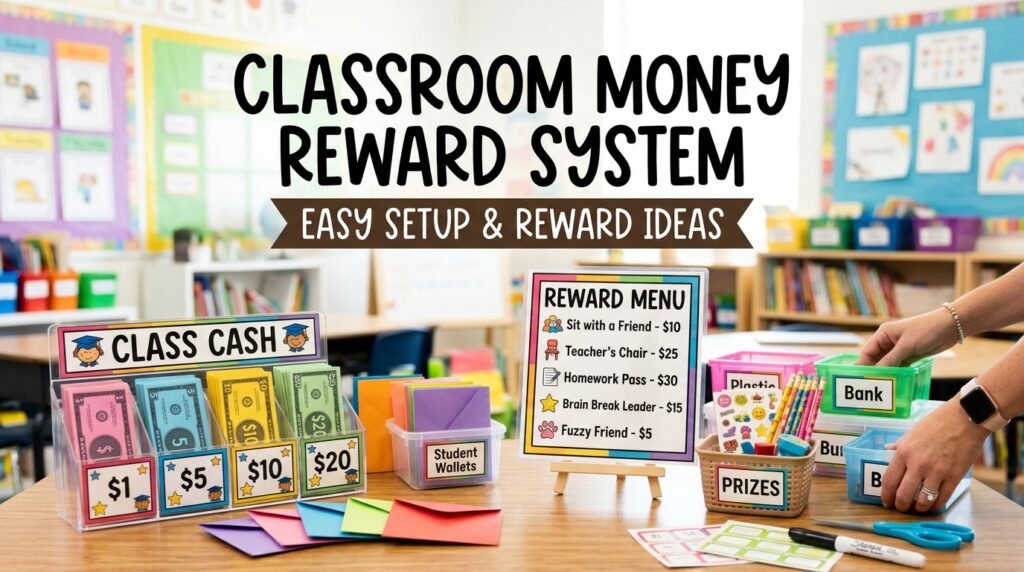
Classroom Money Reward System: Easy Setup and Reward Ideas

A classroom money reward system helps teachers encourage positive behavior, build classroom responsibility, and teach students basic money management through a simple pretend-currency system. Students earn classroom dollars for selected tasks or behaviors and spend them on rewards such as choosing a class activity, getting extra reading time, or visiting a classroom store. The system works best when students understand the rules and know what they can earn.
Teachers can start with a few classroom dollars, a short list of earning opportunities, and affordable rewards. There is no need to create a complicated classroom economy from the beginning. A simple system is often easier to manage, especially for younger students. As students become familiar with earning, spending, and saving, teachers can introduce more choices and responsibilities.
A well-planned classroom money reward system can also introduce basic financial concepts. Students can practice keeping track of their balances, deciding whether to spend or save, and working toward a goal. Research on token economies suggests that structured rewards can support positive classroom behavior when teachers define expectations clearly and apply the system consistently. However, results depend on students’ needs, the classroom environment, and how the system is managed.
In this guide, you will learn how to set up a classroom money reward system, decide how students earn classroom dollars, create a reward price list, and track earnings and spending without adding too much work to your day. You will also find classroom store ideas, printable and digital tracking options, age-specific suggestions, and practical solutions to common problems. The goal is to create a fair, manageable system that supports learning and helps students develop responsible habits.
What Is a Classroom Money Reward System?
A classroom money reward system is a classroom management method in which students earn pretend money for completing tasks or demonstrating positive behavior and exchange it for rewards. Teachers use classroom dollars, paper cash, or digital balances to encourage responsibility, participation, and good classroom habits.
For example, a teacher might give a student $5 for organizing books or helping distribute worksheets. The student can save that money and later spend $10 to choose a class game or enjoy extra reading time. These prices are examples, not fixed amounts.
The system has three basic steps: earn, track, and spend or save. Students earn money for meeting clear expectations, record their balances in a checkbook or tracking sheet, and choose how to use their earnings.
Unlike a points-based system, which tracks progress toward a reward, a classroom money system lets students practice spending and saving decisions. Some teachers expand it into a classroom economy with jobs, regular paydays, and simulated expenses, but these features are optional.
A U.S. Treasury field study of My Classroom Economy found statistically significant improvements in financial knowledge and budgeting behavior after approximately 10 weeks. The findings suggest that classroom economies can support financial learning, although results vary by program and classroom.
How to Set Up a Classroom Money Reward System
Setting up a classroom money reward system starts with choosing clear goals, deciding how students earn pretend money, and setting simple rules for spending it. In my view, teachers should begin with a system they can manage consistently rather than introducing too many rules at once.
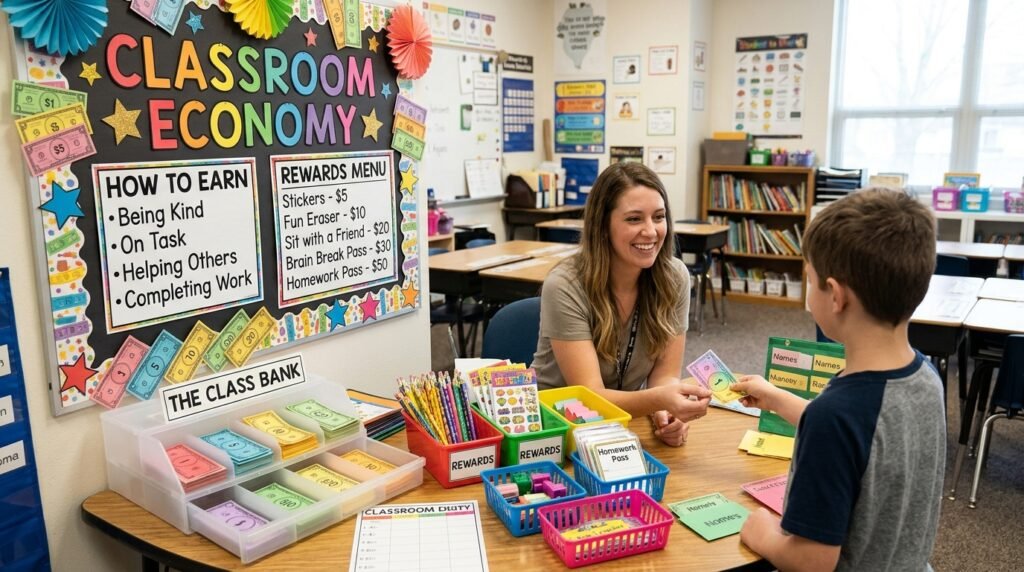
1. Choose the Age Group and Goals
First, decide what you want the system to teach or encourage. For kindergarten and first-grade students, focus on simple routines, such as putting away supplies or following classroom instructions. For grades 3 to 5, include responsibilities such as completing classroom jobs, saving money, and tracking balances.
Choose two or three goals to start. For example, you might want students to complete assigned tasks, help keep the classroom organized, and practice basic budgeting. Clear goals make it easier to decide which actions deserve classroom money.
2. Choose a Classroom Currency
Decide whether students will use printed classroom dollars, paper tokens, or digital balances. Younger students often benefit from colorful play money, while older students may prefer checkbooks or spreadsheets that record earnings and spending.
For example, you could create $1, $5, and $10 classroom bills. A student might earn $5 for organizing books and receive another $2 for helping distribute materials. Keep the currency simple so students can recognize denominations and calculate their balances.
3. Set Clear Earning Rules
Write down exactly how students can earn classroom money. For example, award $5 for completing an assigned classroom job, $3 for returning shared supplies, or $2 for demonstrating teamwork during a group activity. These amounts are examples, not standard rates.
Explain the rules before introducing the system. Apply them consistently, and recognize effort and improvement rather than rewarding only students who already perform well. Avoid making essential learning materials, teacher support, or participation depend on students’ earnings.
4. Decide When Students Receive Their Money
Choose a payment schedule that fits your classroom routine. You could distribute money immediately after a specific task, pay students every Friday, or combine both methods. Immediate rewards can help younger students connect their actions with the expected behavior.
For example, students might receive money for completing classroom jobs during the week, followed by a Friday payday. A short, regular schedule also gives students time to review their earnings and plan their spending.
5. Create Spending Rules and a Reward Menu
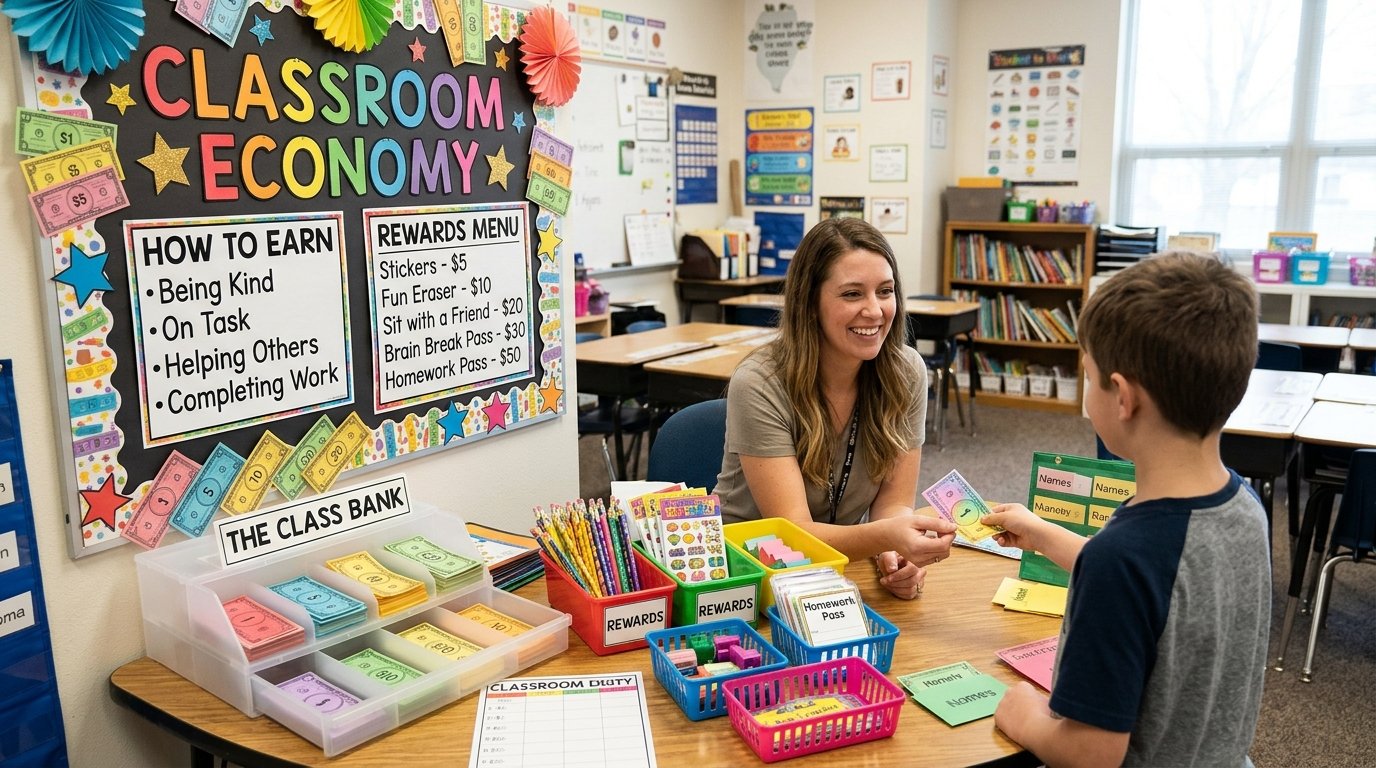
List the rewards students can purchase and assign each one a clear price. Include low-cost options so students do not have to wait too long to experience success. You can offer privileges and activities instead of relying only on physical prizes.
| Classroom reward | Example price |
| Choose a brain-break activity | $5 |
| Enjoy extra reading time | $10 |
| Choose a classroom game | $15 |
| Select an approved seating option | $20 |
| Work toward a special class privilege | $30 |
These prices are illustrative. Adjust them to match how frequently students earn money and how much time they have to save. Set limits on privileges, such as homework passes, so they do not interfere with learning objectives.
6. Start Small and Review the System
Begin with two or three earning rules, five reward choices, and one simple tracking sheet. Stop adding rent, fines, bank accounts, or multiple classroom jobs until students understand the basic process.
Try the system for two to four weeks, then review what works. For example, check whether students understand the rules, whether rewards remain motivating, and whether tracking takes too much teaching time. Ask students for feedback and simplify any steps that create confusion.
The key is consistency, not complexity. A small classroom money reward system with clear expectations is easier to manage, adjust, and expand as students become more independent.
Simple Classroom Money System vs. Full Classroom Economy
A basic classroom money reward system is best when your main goal is to encourage positive behavior, while a full classroom economy is useful when you also want to teach financial management through simulated responsibilities.
A basic system needs only three elements: earning rules, pretend money, and a reward menu. For example, students might earn $5 for organizing books and save $15 to choose a classroom game. This approach works well when teachers want simple routines without extensive recordkeeping.
A full classroom economy adds features such as classroom jobs, student accounts, regular salaries, and simulated expenses. For example, a student might work as a classroom banker, receive a weekly salary, track money in an account, and save toward a purchase. Older students may also practice budgeting for simulated rent or bills.
| Feature | Basic reward system | Full classroom economy |
| Main purpose | Encourage target behaviors | Teach behavior, responsibility, and financial skills |
| Currency | Classroom dollars or tokens | Classroom dollars and tracked balances |
| Student jobs | Optional | Often included |
| Expenses and bills | Usually excluded | Optional simulated expenses |
| Teacher workload | Lower | Higher |
Start with the basic system if you have limited time or teach younger students. Consider a full classroom economy when students can follow the rules independently and you have time to manage accounts and responsibilities. Simulated fines and expenses are optional, and essential learning opportunities should never depend on students’ classroom balances.
Ways Students Can Earn Classroom Money
Students can earn classroom money by completing assigned classroom jobs, following routines, participating in lessons, and showing responsibility toward shared materials. A clear earning chart helps students understand which actions qualify for rewards and how much each action pays. Teachers should focus on specific expectations rather than rewarding every routine action.
Create a Classroom Money Earning Chart
Set clear earning rules and assign a fixed amount to each task or behavior. For example, students might earn $5 for completing a classroom job, $3 for organizing supplies, or $2 for contributing to a group discussion.
| Task or behavior | Example payment |
| Complete an assigned classroom job | $5 |
| Organize books or supplies | $3 |
| Participate constructively in a lesson | $2 |
| Help a classmate appropriately | $3 |
| Show improvement toward a personal goal | $4 |
| Keep shared materials in good condition | $3 |
These amounts are examples, not standard rates. Post the earning chart where students can review it, and explain how each task is assessed. Keep the rules consistent so students know what to expect.
Reward Classroom Jobs and Responsibility
Classroom jobs give students practical ways to contribute to the learning environment. Examples include distributing worksheets, organizing books, watering classroom plants, and serving as a line leader. Assign jobs through rotation or another fair process so the same students do not receive every opportunity.
Teachers can also reward responsibility, such as returning shared supplies or completing an agreed classroom duty. For example, a student might earn $3 for returning art materials to their proper places. Avoid paying students for every ordinary expectation, since the goal is to develop responsible habits, not make every action transactional.
Recognize Participation, Effort, and Positive Behavior
Students can earn classroom money for constructive participation, kindness, and progress toward personal goals. For example, a student might receive $2 for contributing an idea during a discussion or $3 for working cooperatively with a group.
Reward effort and improvement, not only perfect performance. A student who struggles with a task but makes clear progress should have a fair chance to earn money. Pair rewards with specific feedback, such as, “You shared the materials and helped your group finish the activity.” This tells students which behavior they demonstrated well.
Homework completion can also be included, but teachers should consider differences in home support, access to supplies, and available study time. Avoid making earnings depend entirely on circumstances outside a student’s control.
Keep Earning Opportunities Fair and Accessible
Every student should have a reasonable opportunity to earn classroom money. Rotate classroom jobs, explain expectations in more than one way, and allow suitable adjustments for students with different learning needs.
For example, one student might distribute books while another organizes a supply tray. Both can earn the same amount when they complete their assigned responsibilities. Fairness means providing meaningful opportunities to succeed, not requiring every student to complete identical tasks.
Keep individual balances private, and avoid public rankings that compare students’ earnings. Do not remove previously earned money as a punishment. Instead, address misbehavior through clear classroom consequences and use the money system to reinforce the behaviors you want students to develop.
How to Create a Classroom Store and Reward Price List
To create a classroom store, choose rewards students value, assign fair prices, and offer options that students can afford quickly or save for over time. A well-planned store gives students practice making choices while helping teachers reinforce classroom goals without spending too much money.
Start by listing rewards that fit your students’ ages and classroom rules. For example, younger students might enjoy choosing a read-aloud book or using a special pencil, while older students might prefer selecting a class activity or choosing an approved seating option. Rewards do not need to cost money; many classroom privileges use resources teachers already have.
Set prices according to how often students earn classroom dollars and how long you want each reward to take to earn. For example, if students earn $5 for a classroom job, a $10 reward may be reachable within a few opportunities. A $40 reward encourages longer-term saving. These amounts are examples, not fixed standards.
Include a mix of small rewards, classroom privileges, and larger special activities. Keep some low-cost choices available so students experience progress, but avoid making every reward easy to earn immediately. Review the menu periodically and check that students can access rewards fairly.
Sample Classroom Money Price List
Use this sample price list as a starting point. Adjust the amounts to match your earning chart, student age, and classroom budget.
| Reward | Example price |
| Choose a classroom pencil or sticker | $5 |
| Enjoy 10 minutes of extra reading time | $10 |
| Help the teacher with an approved task | $10 |
| Choose a brain-break activity | $15 |
| Select the class read-aloud book | $20 |
| Choose an approved class activity | $25 |
| Use a homework pass, where appropriate | $30 |
| Save toward a special classroom activity | 40–50 |
These prices are illustrative. A homework pass should never replace essential practice, required assessments, or work needed to meet learning goals. Similarly, helping the teacher should be an optional privilege, not a substitute for necessary classroom support.
To keep the store balanced, offer at least three low-cost rewards and two higher-cost choices. For example, students might spend $5 on a sticker, $10 on extra reading time, or save $40 toward a special activity. This gives students different ways to use their money without requiring every student to choose the same reward.
Teachers can run the store every Friday or on another regular schedule. Students bring their classroom checkbooks or balance sheets, choose an available reward, and record the purchase. A consistent routine makes the store easier to manage and helps students practice basic budgeting.
How to Track Classroom Money, Spending, and Savings
Teachers can track classroom money by recording each student’s starting balance, earnings, spending, and remaining balance in a checkbook, tracking sheet, spreadsheet, or digital tracker. A consistent record helps students understand how much money they have and prevents disagreements about payments or purchases.
For example, a student starts the week with $5, earns $8 for completing classroom jobs, and spends $4 at the classroom store. The student has $9 remaining. Students can check their balances before buying rewards and decide whether to spend their money or save it.
Choose a Classroom Money Tracking Method
Choose a tracking method that matches your students’ ages and the time you have available. Younger students may need printed records, while older students can manage their own transactions with teacher supervision.
| Tracking method | How it works | Best suited for |
| Paper classroom cash | Students keep pretend bills in labeled envelopes or wallets | Younger students learning currency |
| Student checkbooks | Students record deposits, purchases, and balances | Students practicing basic arithmetic |
| Tracking sheets | Students list earnings and spending on a simple worksheet | Individual or weekly tracking |
| Teacher ledger | The teacher records each student’s transactions | Classes needing centralized records |
| Spreadsheet | The teacher or students update digital balances | Older students and larger classes |
| Digital tracker | Students view balances and record transactions through an approved tool | Classrooms with reliable device access |
Paper cash makes transactions visible, but students can lose it. Checkbooks teach recordkeeping, but entries need checking. Spreadsheets and digital trackers simplify calculations, but require devices and careful access controls.
Teach Students to Save and Budget
Help students set a savings goal before they spend their classroom money. For example, a student with $10 might spend $5 on extra reading time and save the remaining $5 toward a $20 classroom privilege. This introduces the difference between an immediate purchase and a longer-term goal.
Teach students to ask three questions before spending:
- How much money do I have? Check the current balance.
- How much will this reward cost? Compare the price with the available balance.
- How much will remain afterward? Subtract the purchase price and decide whether the remaining amount supports the savings goal.
Teachers should not force students to save every dollar. Instead, let them practice making choices and discuss the results. For younger students, use simple amounts and visual aids. Older students can set weekly budgets and compare several reward options.
Sample Classroom Money Tracking Sheet
Use this simple example to show how a student can record money earned and spent during one week.
| Transaction | Amount |
| Starting balance | $5 |
| Money earned from classroom jobs | +$8 |
| Money earned for teamwork | +$2 |
| Money spent at the classroom store | -$4 |
| Ending balance | $11 |
Calculate the ending balance using this formula:
Ending balance = Starting balance + Money earned − Money spent
In this example, the student starts with $5, earns $10, and spends $4, leaving $11. Students should update their records after every transaction or during a regular class check-in.
For easier recordkeeping, teachers can add columns for the date, transaction description, amount earned, amount spent, and new balance. Younger students may use symbols or color-coded bills, while older students can maintain a running balance independently.
Keep individual balances private and review records regularly. This helps students learn accountability without turning classroom earnings into a public competition.
Free Classroom Money Printables, Templates, and Digital Tools
Free classroom money printables and digital tools help teachers create, manage, and track a classroom money reward system without building every resource from scratch. The most useful materials include printable classroom dollars, earning charts, reward store menus, student checkbooks, and money-tracking sheets. Teachers can start with paper resources and move to digital tracking when students are ready.
Essential Classroom Money Printables and Templates
You do not need a large collection of materials to get started. Begin with five resources that explain how students earn, manage, and spend their classroom money.
- Printable classroom money: Create $1, $5, and $10 bills that students can recognize and exchange.
- Classroom money earning chart: List specific actions and their payment amounts, such as $5 for completing an assigned classroom job.
- Classroom store menu: Display rewards and prices, such as $10 for extra reading time or $20 for choosing an approved classroom activity.
- Student checkbook: Give students a place to record deposits, purchases, and remaining balances.
- Classroom money tracking sheet: Record starting balances, money earned, money spent, and ending balances.
For example, a student might use the earning chart to check how much a classroom job pays, consult the store menu before purchasing a reward, and record the transaction in a checkbook. Keeping these resources consistent makes the system easier to understand.
Paper-Based vs. Digital Classroom Money Systems
Paper-based systems are often easier to introduce, while digital systems can simplify calculations and recordkeeping. The right choice depends on your students’ ages, classroom technology, and available teaching time.
| Feature | Paper-based system | Digital system |
| Currency | Printed bills or tokens | Recorded digital balances |
| Tracking | Checkbooks and worksheets | Spreadsheets or digital trackers |
| Main benefit | Hands-on money practice | Faster balance updates |
| Common challenge | Lost bills and manual calculations | Device access and setup |
| Best fit | Younger students and simple systems | Older students or larger classes |
A paper system works well when students are learning currency values and basic addition. For example, students can count three $5 bills to confirm they have $15. A digital spreadsheet can calculate the same balance automatically and help teachers review multiple student accounts.
Digital tools should be approved for classroom use and protect student information. Teachers should also maintain a reliable record of balances, even when students use printed money.
How to Choose the Right Resources
Choose materials that solve your immediate classroom needs instead of adding unnecessary steps. If you are introducing the system to younger students, start with printable bills, one earning chart, and a short reward menu. Add checkbooks when students are ready to record transactions.
If you teach older students, a spreadsheet or digital tracker may be more practical. For example, a teacher can record weekly earnings in one table and calculate each student’s balance without counting every paper bill.
Before using a printable or template, check that the currency denominations match your earning chart, the reward prices are easy to read, and the tracking sheet includes all necessary calculations. Test the system with a few sample transactions before introducing it to the class.
Start with the simplest setup you can manage consistently. You can add more printable resources, student accounts, or digital features as your classroom money system develops.
How to Keep a Classroom Money Reward System Fair and Effective
A classroom money reward system works best when every student understands the rules, has fair earning opportunities, and receives consistent feedback. Teachers should explain how students earn, spend, and save classroom dollars before introducing the system. They should also review the rules regularly to make sure the system supports learning rather than creating competition.
Establish Clear and Consistent Rules
Create a written earning chart and reward menu that students can check whenever they need clarification. For example, award $5 for completing an assigned classroom job and $3 for organizing shared supplies. Apply the same criteria to students performing comparable tasks.
Explain how you will handle missed payments, lost cash, and incorrect balances. For example, a student who believes they earned $5 should be able to check the transaction record with the teacher. Consistent records reduce confusion and help students understand accountability.
Keep Student Balances Private
Avoid displaying individual balances or ranking students by how much money they earn. Public comparisons can create embarrassment and discourage students who have fewer earning opportunities. Instead, let students check their balances privately through a personal checkbook, tracking sheet, or approved digital account.
Make sure every student has a reasonable way to earn classroom money. For example, rotate classroom jobs such as distributing worksheets, organizing books, and caring for shared materials. Offer suitable alternatives when students have different learning needs or responsibilities.
Handle Misbehavior Without Excessive Fines
Use classroom money mainly to recognize specific positive behaviors. Avoid routinely taking away money students have already earned as punishment. Removing earned rewards can make the system unpredictable and shift attention away from learning the expected behavior.
For example, if a student interrupts a lesson, remind them of the classroom discussion rule and explain what appropriate participation looks like. You can address repeated behavior through established classroom procedures rather than automatically deducting $5. Keep consequences separate from the earning system whenever possible.
Encourage Positive Habits Beyond Rewards
Classroom money can help students practice routines, but it should not become the only reason they behave responsibly. Pair rewards with specific praise, student choice, and explanations of why an action helps the class.
For example, tell a student, “You returned the books neatly, so everyone can find them tomorrow.” You can also let students choose between two approved tasks or set personal improvement goals. As positive habits develop, gradually reduce the frequency of rewards for behaviors students can manage independently.
Classroom Money Reward System Ideas for Different Ages
The best classroom money system matches students’ developmental levels, counting skills, and ability to manage responsibilities. Younger children need simple rules and immediate feedback, while older students can manage more detailed records and make longer-term spending decisions.
Kindergarten and First Grade
For kindergarten and first-grade students, use visual classroom dollars, simple earning rules, and rewards they can reach quickly. For example, students might earn one token for putting away blocks or $2 for following the classroom cleanup routine.
Keep the reward menu short, with options such as choosing a read-aloud book, selecting a brain-break activity, or using a special classroom pencil. Review balances with students and use pictures or color-coded bills to make counting easier.
Grades 2–3
Students in grades 2–3 can begin managing classroom jobs, simple checkbooks, and small savings goals. For example, a student might earn $5 for distributing worksheets and record the payment in a personal tracking sheet.
Introduce basic spending choices. A student could spend $5 on a small privilege or save $15 for a larger reward. Use these activities to practice addition, subtraction, and planning without making the system difficult to follow.
Grades 4–5
For grades 4–5, add budgeting, rotating classroom jobs, and more independent recordkeeping. Students might work as classroom bankers, supply managers, or materials organizers, with clearly defined responsibilities and payment amounts.
Ask students to set a savings goal and track progress each week. For example, a student who wants a $30 reward and has $12 can calculate that another $18 is needed. These decisions introduce planning and delayed gratification through familiar classroom activities.
Middle School
Middle school students can handle more detailed accounts and simulated financial decisions. Teachers may introduce weekly salaries for classroom jobs, savings targets, and optional expenses such as simulated rent or bills. For example, students might record income, subtract a simulated expense, and calculate their remaining balance.
Students can also compare costs, create budgets, or evaluate whether a purchase fits their goals. Keep the simulation manageable and explain that classroom currency is pretend money, not real income. Avoid penalties that unfairly disadvantage students who need additional support or have fewer opportunities to earn.
Common Classroom Money System Problems and How to Fix Them
Even a well-planned classroom money system can create problems when students misunderstand the rules, lose their cash, or lose interest in the rewards. Simple procedures, accurate records, and regular reviews can make the system easier to manage.
Students Lose Their Classroom Money
Paper bills can get lost, damaged, or mixed up with other materials. Give each student a labeled envelope, wallet, or folder for storing classroom cash. Younger students may also benefit from keeping their money in a designated classroom location.
Maintain a backup record of each student’s balance. For example, if a student loses $10 in pretend bills, the teacher can check the ledger and restore the recorded balance according to the class policy. Explain this procedure before the system begins.
Students Disagree About Payments
Payment disputes often happen when earning rules are unclear or transactions are not recorded promptly. Use a written earning chart and update records whenever students receive or spend money.
For example, if a student believes they earned $5 for organizing supplies, check the agreed criteria and transaction record together. Avoid making decisions based on memory alone. A simple ledger with dates, descriptions, and amounts can help resolve disagreements fairly.
Students Spend Everything Immediately
Some students may spend their classroom dollars as soon as they receive them. This provides an opportunity to teach spending choices without forcing every student to save.
Show students how to compare a small purchase with a larger savings goal. For example, a student with $15 could spend $5 on a small privilege and save $10 toward a $25 reward. Optional savings goals can help students plan while allowing them to decide how to use their money.
Students Lose Interest in the Rewards
A reward menu may stop motivating students when the options become repetitive or no longer match their interests. Ask students which approved privileges and activities they would like to see added.
For example, replace an unpopular prize with choosing a class game, selecting a read-aloud book, or helping plan a brain break. Review the menu periodically, but avoid constantly increasing payments or making every activity dependent on rewards.
Tracking Takes Too Much Time
Manual calculations can become difficult when every student has multiple transactions each day. Choose a payment schedule and tracking method that reduce unnecessary work.
For example, distribute classroom money on Fridays, record purchases at the store, and update balances in one spreadsheet. Older students can help with supervised recordkeeping through rotating roles such as classroom banker. The teacher should retain oversight of records and resolve discrepancies.
Students Expect Money for Every Task
Paying students for every routine action can make the system difficult to maintain. It may also encourage students to expect a reward for behavior that should become a normal classroom habit.
Reserve classroom money for selected goals, such as completing an assigned job, demonstrating improvement, or taking responsibility for shared materials. Continue to teach ordinary expectations through instruction, routines, and feedback. Not every helpful action needs a financial reward.
The System Becomes Too Complicated
Adding jobs, expenses, fines, accounts, and multiple payment schedules can overwhelm students and increase teacher workload. Remove features that do not support a clear learning goal.
For example, return to three earning rules, five reward choices, and one tracking sheet. Add more features only when students understand the existing process and the extra work serves a specific purpose.
Does a Classroom Money Reward System Work?
A classroom money reward system can support positive classroom behavior and teach basic money-management skills when teachers use clear rules, consistent feedback, and appropriate rewards. However, its effectiveness depends on student needs, the behaviors being targeted, and how the system is implemented.
Potential Benefits for Classroom Behavior
Token-economy systems have been studied as ways to encourage specific behaviors and reduce disruptive actions. A meta-analysis of 24 studies examined token-economy interventions involving students from kindergarten through fifth grade and reported large effects across the included studies.
These findings suggest that structured rewards can help support classroom behavior. However, they do not guarantee that every classroom money system will produce the same results. Teachers should define measurable goals, such as completing assigned tasks, following classroom routines, or participating constructively, and monitor progress over time.
Benefits for Financial Literacy and Responsibility
Classroom money systems also give students practical experience with earning, spending, saving, and calculating balances. For example, a student who earns $10 and spends $4 can calculate the remaining $6 and decide whether to save it toward a larger reward.
A U.S. Treasury field study of My Classroom Economy found statistically significant gains after approximately 10 weeks in financial knowledge, budgeting behavior, financial socialization, and economic experience outside school. The reported effects were 0.13, 0.11, 0.19, and 0.21 standard deviations, respectively. These results relate to that specific program and should not be interpreted as guaranteed improvements for all students.
Limitations Teachers Should Consider
A classroom money system requires time to prepare currency, explain rules, update balances, and manage rewards. A complex economy with jobs and simulated expenses may add even more work.
There is also a risk of relying too heavily on external rewards. Students may focus on earning money instead of understanding why a behavior matters. To address this, combine rewards with specific praise, meaningful choices, and opportunities to develop independence. Never make essential learning materials or classroom support conditional on earnings.
How to Tell Whether Your System Is Working
Review the system against the goals you selected at the beginning. For example, if your goal is to improve classroom routines, observe whether students complete assigned jobs more consistently. If your goal is financial literacy, check whether students can calculate balances and explain basic saving decisions.
Use three sources of feedback:
- Behavior patterns: Track whether the target behaviors improve over time.
- Student feedback: Ask which rules and rewards are clear, useful, or confusing.
- Teacher workload: Check whether recordkeeping and store management remain manageable.
Review the results after a few weeks and adjust the earning chart, reward prices, or tracking method as needed. If students begin demonstrating positive habits independently, reduce rewards for those behaviors gradually while continuing to recognize their progress.
The goal is not simply to distribute classroom money. It is to support positive habits, responsible choices, and practical learning. A simple system that meets these goals is often more useful than a complicated economy that takes time away from teaching.
Frequently Asked Questions About Classroom Money Reward Systems
1. What Is the Purpose of a Classroom Money Reward System?
A classroom money reward system encourages positive behavior while teaching students basic money-management skills. Students earn classroom dollars for agreed-upon tasks or jobs and spend or save them for rewards. The system can also introduce budgeting, saving, and responsible decision-making.
2. How Do Students Earn Classroom Money?
Students can earn classroom money by completing classroom jobs, following routines, participating in lessons, and showing responsibility or kindness. Teachers should explain the earning rules in advance and apply them consistently. Recognizing effort and improvement helps provide opportunities for students with different strengths.
3. What Rewards Can Students Buy With Classroom Money?
Students can exchange classroom money for small prizes, classroom privileges, or special activities. Examples include choosing a class game, selecting a read-aloud, or helping the teacher. Offering free rewards and experiences can reduce costs while keeping the system engaging.
4. How Much Classroom Money Should Students Earn?
There is no standard amount that every classroom should use. Teachers can set simple payments based on the task and price rewards so students can earn smaller rewards regularly while saving for larger ones. Consistent rules matter more than the exact dollar amounts.
5. How Do You Make a Classroom Money Reward System Fair?
Make the system fair by giving every student clear, accessible ways to earn classroom money. Avoid rewarding only academic performance or speed, and recognize effort, improvement, and responsibility. Do not publicly compare student balances or make access to basic needs depend on classroom earnings.
6. Can You Use Classroom Money Without Buying Prizes?
Yes, you can exchange classroom money for privileges and activities instead of physical prizes. Options include choosing a class activity, leading a game, or selecting a read-aloud. These rewards can reduce expenses and help teachers maintain a classroom store without regularly purchasing supplies.
7. Is a Classroom Money System Better Than a Points-Based Reward System?
A classroom money system is useful when teachers want to teach saving, spending, and budgeting alongside positive behavior. A points-based system may be easier when the main goal is tracking progress toward a reward. The better option depends on the students’ ages, learning goals, and available time.
8. How Do You Track Classroom Money Without Spending Too Much Time?
Use a simple tracking sheet, student checkbook, spreadsheet, or digital classroom economy tool. Record money earned, money spent, and the remaining balance regularly. For younger students, paper money may be easier to understand, while digital records can simplify calculations and account management.
9. Are There Free Printable Classroom Money Templates?
Yes, teachers can use free printable classroom money, earning charts, reward menus, and tracking sheets. A basic set should include classroom currency, earning rules, reward prices, and a balance record. Check the resource’s terms and adapt its materials to your students’ needs before using it.
10. What Are the Disadvantages of a Classroom Money Reward System?
The main disadvantages are extra preparation, recordkeeping, and the risk that students become too focused on rewards. A complicated system can also take time away from instruction. Keep the rules simple, use affordable rewards, and review whether the system supports your classroom goals.
11. How Do You Set Up a Classroom Money Reward System?
Start by choosing two or three classroom goals, creating clear earning rules, and selecting a few affordable rewards. Prepare classroom money and a tracking sheet before explaining the system to students. Test it for a short period, then adjust the rules based on student understanding and workload.
12. Should Students Lose Classroom Money for Bad Behavior?
Teachers should be cautious about deducting classroom money for misbehavior because frequent penalties can make the system overly punitive. Clear expectations, behavior-specific feedback, and appropriate consequences should remain central. If deductions are used, explain the rules beforehand and apply them consistently.
13. Can Digital Tools Replace Paper Classroom Money?
Yes, digital tools can replace paper classroom money when students and teachers have suitable device access. Spreadsheets and classroom economy platforms can record earnings, purchases, and balances. Paper currency may be more practical for younger students who benefit from hands-on counting and handling money.
14. How Can Teachers Tell Whether the System Is Working?
Teachers can assess the system by reviewing progress toward their original goals, such as improved classroom routines, participation, and responsibility. Student feedback and the time required to manage the system also matter. If rewards create excessive competition or extra work, simplify the system or reconsider its approach.