
Blue Nile vs Rare Carat: Which Is Better for Buying a Diamond?

Choosing where to buy a diamond can be almost as difficult as choosing the diamond itself. Blue Nile vs Rare Carat is a comparison many shoppers make because both retailers offer a large selection of diamonds online and provide tools to help buyers compare stones.
But which one is better?
The answer depends on what matters most to you. Blue Nile has a long-established reputation in online diamond retail and offers natural and lab-grown diamonds, jewelry settings, diamond upgrades, and customer support. Rare Carat takes a more comparison-focused approach, with tools designed to help shoppers evaluate diamonds across the market.
Neither retailer is automatically the right choice for every buyer. The better option depends on your budget, whether you want a natural or lab-grown diamond, how much guidance you need, and which return or upgrade policy matters to you.
This Blue Nile vs. Rare Carat comparison highlights the key differences so you can decide where to shop with greater confidence.
Blue Nile vs Rare Carat at a Glance
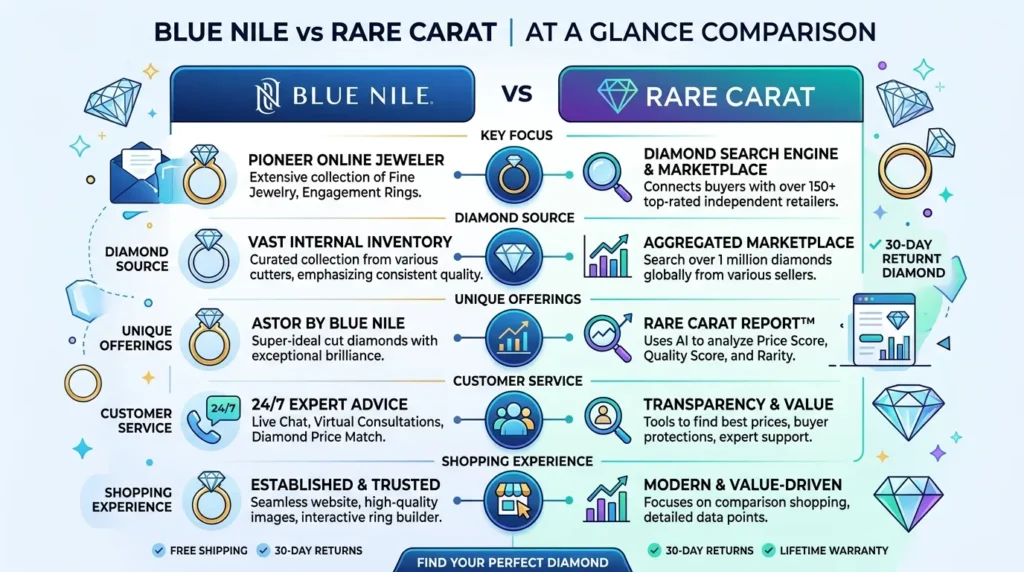
| Feature | Blue Nile | Rare Carat |
|---|---|---|
| Natural diamonds | Yes | Yes |
| Lab-grown diamonds | Yes | Yes |
| Engagement rings | Yes | Yes |
| Loose diamonds | Yes | Yes |
| Diamond comparison tools | Yes | Strong comparison focus |
| Diamond certificates | GIA, IGI, and others depending on stone | Varies by diamond |
| Customization | Extensive | Extensive |
| Return policy | Free returns on eligible purchases | Return terms apply by product |
| Diamond upgrade program | Available on eligible certified diamonds | Available options vary |
| Online buying | Yes | Yes |
| Best for | Traditional online diamond shopping | Comparing diamonds and finding value |
Policies and product selections can change, so shoppers should check the specific terms attached to the diamond or ring they are considering.
What Is the Difference Between Blue Nile and Rare Carat?
The biggest difference is how each company approaches online diamond shopping.
Blue Nile is a large online jewelry retailer with a wide selection of engagement rings. wedding bands, loose diamonds, and other jewelry. Its diamond listings provide detailed information about characteristics such as carat weight, color, clarity, cut, measurements, and grading reports. Blue Nile also offers features such as a lifetime diamond upgrade program on eligible certified diamonds.
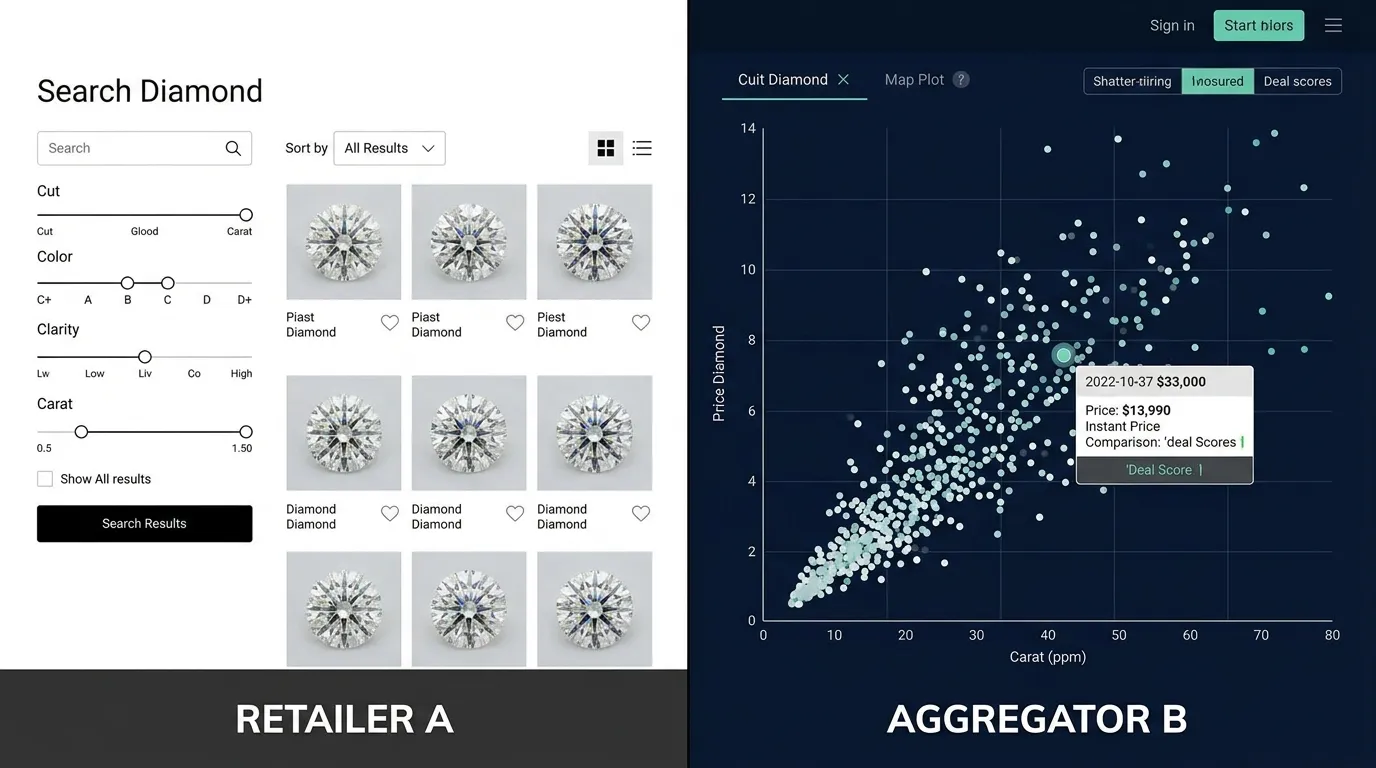
Rare Carat puts a strong emphasis on comparing diamonds and helping shoppers evaluate their options before buying. This can appeal to buyers who want to spend time comparing similar stones rather than simply selecting a ring design.
In simple terms:
Blue Nile feels more like a traditional online jewelry retailer, while Rare Carat places greater emphasis on diamond comparison and shopping guidance.
Blue Nile vs Rare Carat: Which Has Better Prices?
Price is one of the first things most diamond shoppers want to compare.
However, there’s a catch.
You shouldn’t compare two diamonds based only on carat weight and price.
A 1-carat diamond from one retailer isn’t necessarily equivalent to a 1-carat diamond from another retailer.
You need to compare:
- Carat weight
- Cut
- Color
- Clarity
- Shape
- Measurements
- Certification
- Fluorescence
- Polish
- Symmetry
- Proportions
- Diamond origin
This is particularly important with lab-grown diamonds, where prices can vary considerably.
Blue Nile currently lists a broad selection of lab-grown diamonds. Individual listings show certification from organizations such as GIA and IGI, along with detailed specifications and current prices.
For example, Blue Nile listings currently include lab-grown diamonds ranging from about 1 carat to several carats, with prices varying widely based on the stone’s characteristics.
The better approach
Rather than asking:
“Which company is cheaper?”
Ask:
“Which company offers the better diamond for the same budget?”
That is a much more useful comparison.
Blue Nile vs Rare Carat for Natural Diamonds
If you want a natural diamond, both retailers can be worth considering.
Natural diamonds are priced according to a combination of rarity, market conditions, and the stone’s individual characteristics.
The four familiar grading factors are:
- Cut
- Color
- Clarity
- Carat
But those four characteristics don’t tell the entire story.
Two diamonds with identical GIA grades can still look noticeably different because of their proportions, measurements, and visual performance.
This is particularly important with round brilliant diamonds.
When comparing a natural diamond from Blue Nile with one from Rare Carat, look beyond the headline grade.
Check the actual grading report and compare the stone’s measurements and proportions.
Blue Nile vs Rare Carat for Lab-Grown Diamonds
This is where the comparison becomes especially interesting.
Lab-grown diamonds have become a major part of the online diamond market because they can offer substantially more carat weight for the same budget.
Blue Nile currently has a significant selection of lab-grown diamonds, including stones graded by GIA and IGI.
For example, Blue Nile currently lists lab-grown diamonds in sizes above 2 carats at prices that are generally far below comparable natural diamonds.
Rare Carat also has a strong presence in the lab-grown market.
Which is better?
If your priority is maximum size for your money, lab-grown diamonds are worth considering regardless of which retailer you choose.
The more important question becomes:
Which retailer has the better individual stone at the time you’re shopping?
Lab-grown inventory changes frequently, so the best deal can move from one retailer to another.
Blue Nile vs Rare Carat: Diamond Selection
A large inventory sounds impressive, but size isn’t everything.
The real benefit of a large selection is that you can find a diamond with the combination of:
- Good cut
- Attractive proportions
- Suitable color
- Clean clarity
- Appropriate size
- Strong certification
- Reasonable price
Blue Nile’s online listings provide detailed diamond information, including certification and measurements.
Rare Carat’s comparison-oriented shopping experience can also be useful when you’re trying to narrow down several similar stones.
Winner: Depends on the shopper
If you already know exactly what you want, either platform can work well.
If you’re still learning how diamonds are evaluated, comparison tools and expert guidance can become more important than the sheer number of stones available.
Blue Nile vs Rare Carat: Diamond Certification
Certification is one of the most important parts of buying a diamond online.
A grading report provides an independent assessment of the stone’s characteristics.
Two major names you’ll encounter are:
GIA — Gemological Institute of America
IGI — International Gemological Institute
Blue Nile listings currently include both GIA- and IGI-graded lab-grown diamonds.
When comparing diamonds, don’t just look for the word “certified.”
Find out:
- Which laboratory graded the diamond?
- Is the report available?
- Does the report number match the stone?
- What does the report say about cut, color, and clarity?
- Do the measurements make sense for the diamond’s shape?
For a major purchase, reading the grading report is worth the extra few minutes.
Blue Nile vs Rare Carat for Engagement Rings
If you are buying an engagement ring, you need to evaluate both the center diamond and the setting
You’re evaluating both the diamond and the setting.
Important factors include:
- Metal type
- Ring design
- Prong style
- Setting height
- Band width
- Side stones
- Diamond shape
- Ring size
- Customization
- Warranty
- Return policy
Blue Nile offers a wide selection of engagement ring settings and allows shoppers to pair diamonds with different designs.
Rare Carat also focuses heavily on engagement rings and customization.
Which is better?
If you want a classic engagement-ring shopping experience with a large jewelry selection, Blue Nile is a strong option.
If you want more guidance while comparing the diamond itself, Rare Carat may be more appealing.
Blue Nile vs Rare Carat: Customization
Customization can make a major difference if you already have a specific ring design in mind.
You may want:
- A round diamond in a solitaire setting
- An oval diamond with a hidden halo
- When choosing a custom ring, consider how the setting, center stone, metal choice, side stones, profile height, and band width work together.
- A three-stone ring
- A platinum setting
- A lab-grown center stone
- A natural diamond with side stones
Both companies offer customization options, although the exact choices depend on the ring and diamond.
When comparing customized rings, don’t look only at the final price.
Check what you’re getting for that price.
A cheaper ring may have differences in:
- Metal weight
- Side-stone quality
- Setting construction
- Diamond specifications
- Warranty coverage
Blue Nile vs Rare Carat: Return Policies
A generous return policy can make buying a diamond online less stressful.
Blue Nile currently advertises free returns on eligible purchases and describes its return process as part of its customer-care offering.
However, return eligibility can depend on the product, customization, and applicable terms.
This is important because customized jewelry can have different return conditions from standard products.
Before ordering, check:
- Return window
- Whether the ring is eligible for return
- Whether customized products can be returned
- How return shipping works
- Whether the refund covers the full purchase price
- How long refunds take
Don’t assume that every item follows the same policy.
Blue Nile vs Rare Carat: Diamond Upgrade Options
If you think you might want a larger or higher-quality diamond in the future, an upgrade policy could be valuable.
Blue Nile currently offers a lifetime diamond upgrade program on select certified diamonds. Eligibility and specific conditions apply.
This can be useful for someone who plans to start with a smaller diamond and potentially upgrade later.
However, don’t buy a diamond solely because an upgrade program sounds attractive.
Read the actual terms.
Check:
- Which diamonds qualify
- Minimum upgrade requirements
- How much you need to spend on the new diamond
- Whether the original diamond must meet specific criteria
- Whether the program applies to natural, lab-grown, or both
The rules can differ substantially between retailers.
Blue Nile vs Rare Carat: Customer Service
Buying a diamond online can feel intimidating, particularly if you have never purchased one before.
Customer service matters because you may have questions about:
- Cut quality
- Certification
- Diamond proportions
- Ring sizing
- Shipping
- Returns
- Customization
- Insurance
- Upgrades
Blue Nile provides access to diamond and jewelry consultants, including consultation options shown on individual diamond listings.
Rare Carat has also built its shopping experience around helping consumers compare and understand diamonds.
Which has better customer service?
This is harder to measure objectively.
Customer service experiences can vary from one shopper to another.
If you’re a first-time buyer, look for a retailer that provides clear answers rather than simply pushing you toward the most expensive stone.
Blue Nile vs Rare Carat for First-Time Diamond Buyers
If you’ve never purchased a diamond before, you may feel overwhelmed by terms such as:
- Table
- Depth
- Crown angle
- Pavilion angle
- Fluorescence
- VS1
- VS2
- VVS
- Excellent
- Ideal
- Polish
- Symmetry
Evaluating a diamond takes some practice, but buyers do not need to become gemologists to make a thoughtful decision.
But you should understand the basic factors that influence appearance.
For beginners, focus on:
1. Cut first
A well-cut diamond can appear brighter and more attractive than a poorly cut stone with a higher color or clarity grade.
2. Check the certification
Know which laboratory graded the diamond.
3. Look at the actual measurements
Don’t rely only on the headline specifications.
4. Compare several stones
Don’t buy the first diamond that looks acceptable.
5. Stay within your budget
A beautiful diamond doesn’t need to have the highest possible grades.
Which Is Better for Finding a Good Diamond?
This is where the Blue Nile vs Rare Carat debate becomes less about the company and more about how you shop.
Suppose you have a budget of $5,000.
Instead of immediately choosing one retailer, compare several diamonds with similar:
- Carat weight
- Shape
- Cut
- Color
- Clarity
- Certification
Then examine the individual stones.
You might discover that one retailer has a significantly better diamond for the same money.
The winner can change depending on inventory.
Blue Nile vs Rare Carat: Pros and Cons
Blue Nile Pros
- Long-established online diamond retailer
- Large jewelry selection
- Natural and lab-grown diamonds
- GIA and IGI-certified stones available
- Detailed diamond listings
- Diamond upgrade program on eligible stones
- Free returns on eligible purchases
- Engagement-ring customization
Blue Nile Cons
- Large inventory can feel overwhelming
- Not every diamond has the same grading laboratory
- Some shoppers may want more hands-on guidance
- Prices need to be compared on an individual-stone basis
Rare Carat Pros
- Strong focus on diamond comparison
- Helpful for shoppers researching multiple stones
- Natural and lab-grown options
- Engagement-ring customization
- Useful for buyers who want to compare specifications before choosing
- Strong emphasis on helping consumers understand diamond value
Rare Carat Cons
- Large amounts of information can overwhelm beginners
- Inventory and prices change
- Individual diamond quality still needs to be assessed carefully
- Return and customization terms should be checked before ordering
Blue Nile vs Rare Carat: Which Is Cheaper?
There is no permanent winner.
Diamond prices change based on:
- Carat weight
- Shape
- Color
- Clarity
- Cut
- Certification
- Market conditions
- Inventory
- Promotions
The same specifications can also produce different-looking diamonds.
This means you shouldn’t decide that Blue Nile is always cheaper or Rare Carat is always cheaper.
Instead, compare like for like.
For example:
| Factor | Diamond A | Diamond B |
|---|---|---|
| Carat | 1.50 ct | 1.50 ct |
| Shape | Round | Round |
| Color | G | G |
| Clarity | VS2 | VS2 |
| Cut | Excellent | Excellent |
| Certification | GIA | GIA |
| Price | $X | $Y |
Only then can you make a meaningful price comparison.
Should You Buy a Natural or Lab-Grown Diamond?
This decision may matter more than whether you choose A or B: Blue Nile or Rare Carat.
Choose natural if you value:
- Geological origin
- Natural rarity
- Traditional diamond ownership
- A natural stone’s history
- Potentially stronger secondary-market demand compared with lab-grown diamonds
Consider lab-grown if you value:
- Lower purchase price
- Larger carat size for your budget
- Modern production methods
- Getting higher color and clarity grades within a fixed budget
Lab-grown diamonds have the same basic carbon crystal structure as natural diamonds, but their origins are different.
One isn’t automatically “better.”
They’re different purchasing choices.
A Smart Way to Compare Blue Nile and Rare Carat
Instead of browsing randomly, follow this process.
Step 1: Set your total budget
Set a total budget that includes the diamond, setting, taxes, shipping, insurance, resizing, and any future maintenance costs.
Step 2: Choose natural or lab-grown
This can dramatically change the diamonds available within your budget.
Step 3: Pick a shape
Round, oval, cushion, emerald, pear, princess, and radiant diamonds can have very different pricing.
Step 4: Establish your minimum requirements
For example:
- 1.25–1.50 carats
- G color or better
- VS2 clarity or better
- Excellent cut
- GIA certification
Step 5: Compare individual diamonds
Don’t stop at the headline specifications.
Step 6: Inspect the grading report
Make sure the report belongs to the specific diamond.
Step 7: Compare the setting
The diamond isn’t the entire ring.
Step 8: Read the return policy
Especially if you’re buying online.
Step 9: Compare warranties and upgrades
These can matter throughout the life of the ring
Step 10: Choose the best overall value
The cheapest diamond isn’t always the best purchase.
Blue Nile vs Rare Carat: Which One Should You Choose?
There’s no single answer for every shopper.
Choose Blue Nile if:
- You want a large established online jewelry retailer.
- You prefer a wide range of engagement-ring designs.
- You want access to natural and lab-grown diamonds.
- You value an established diamond upgrade program.
- You want detailed individual diamond listings.
- You prefer a more traditional jewelry-shopping experience.
Choose Rare Carat if:
- You enjoy comparing diamonds before buying.
- You want a shopping experience centered around diamond research.
- You want help understanding the differences between individual stones.
- You want to compare several options before deciding.
- You care strongly about finding value rather than simply choosing a particular retailer.
Consider both if:
You’re making a major purchase.
There’s little reason to restrict yourself to one retailer before you’ve compared the actual diamonds available.
Frequently Asked Questions
Is Blue Nile better than Rare Carat?
Not necessarily. Blue Nile is a strong choice for shoppers who want a broad online jewelry retailer, while Rare Carat may appeal more to shoppers who want a comparison-focused diamond-buying experience.
Is Rare Carat cheaper than Blue Nile?
Neither is consistently cheaper. Diamond prices change frequently, so compare individual stones with similar specifications rather than assuming one retailer always has lower prices.
Does Blue Nile sell lab-grown diamonds?
Yes. Blue Nile currently offers a substantial selection of lab-grown diamonds, including stones with GIA and IGI grading reports.
Does Blue Nile have a diamond upgrade program?
Yes. Blue Nile currently offers a lifetime diamond upgrade program on select certified diamonds, subject to its eligibility requirements.
Is Rare Carat good for first-time buyers?
It can be. Its comparison-focused approach can help shoppers research diamonds, but first-time buyers should still learn the basics of cut, color, clarity, carat, and certification.
Should I compare diamonds from both retailers?
Yes. This is one of the smartest ways to shop. Compare stones with similar specifications and then look at the actual grading reports and prices.
Which is better for lab-grown diamonds?
Both are worth considering. Because lab-grown diamond inventory and pricing can change quickly, compare the specific stones available at the time you purchase.
Which is better for an engagement ring?
Blue Nile may appeal to shoppers who want a broad selection of established engagement ring designs, while Rare Carat may be attractive to buyers who want more focus on comparing center diamonds.
Final Verdict: Blue Nile vs Rare Carat
So, Blue Nile vs Rare Carat—which should you choose?
For a traditional online jewelry-shopping experience, Blue Nile is an excellent option. It offers a broad selection of engagement rings and loose diamonds, natural and lab-grown options, detailed diamond information, free returns on eligible purchases, and a diamond upgrade program for qualifying stones.
For shoppers who want to spend more time comparing individual diamonds and researching value, Rare Carat is worth considering.
But there’s an even better strategy:
Don’t choose the retailer first. Choose the diamond first.
Find several diamonds that meet your requirements, compare their grading reports, examine their proportions and visual appearance, and then compare the total price and purchase terms.
A beautiful, well-cut diamond at a fair price is more important than whether the logo on your receipt says Blue Nile or Rare Carat.
If you’re spending several thousand dollars on an engagement ring, taking an extra hour to compare both retailers could be one of the most valuable parts of the entire buying process.